The Chemistry of "Umami Synergy": How Wagyu Glutamates and Fermented Condiments Trigger Exponential Taste Receptors
Deconstruct the molecular synergy of taste receptors. Discover how free glutamates in Wagyu red meat multiply in umami intensity when paired with the inosinates of soy sauce and miso, and the physics of fresh wasabi's aromatic compounds.
The Molecular Architecture of Taste Dimer Activation
To the casual diner, the combination of Japanese Wagyu beef, soy sauce, and freshly grated wasabi is a traditional pairing born of cultural preference. To the molecular gastronomer, however, it represents a highly sophisticated chemical system engineered to maximize taste bud stimulation. Specifically, this pairing leverages the mathematical phenomenon of Umami Synergism, wherein the combined sensory output of two distinct flavor compounds is exponentially larger than the sum of their individual parts.
At the core of this reaction is the human umami taste receptor, a G-protein-coupled receptor consisting of a heterodimer of two proteins: T1R1 (Taste receptor type 1, member 1) and T1R3 (Taste receptor type 1, member 3).
          [T1R1 Receptor Dimer]               [T1R3 Receptor Dimer]
                  \                                   /
                   +---------------------------------+
                   |   Umami Binding Pocket (Venus)  |
                   +---------------------------------+
                                    |
            Activated by: L-Glutamate (Wagyu) + IMP/GMP (Condiments)
                                    |
                 ========> EXPONENTIAL SYNERGY <========
Understanding how Wagyu's biological composition interacts with these receptors reveals the molecular brilliance of traditional Japanese seasonings.
Intramuscular Amino Acid Profiles in Japanese Wagyu
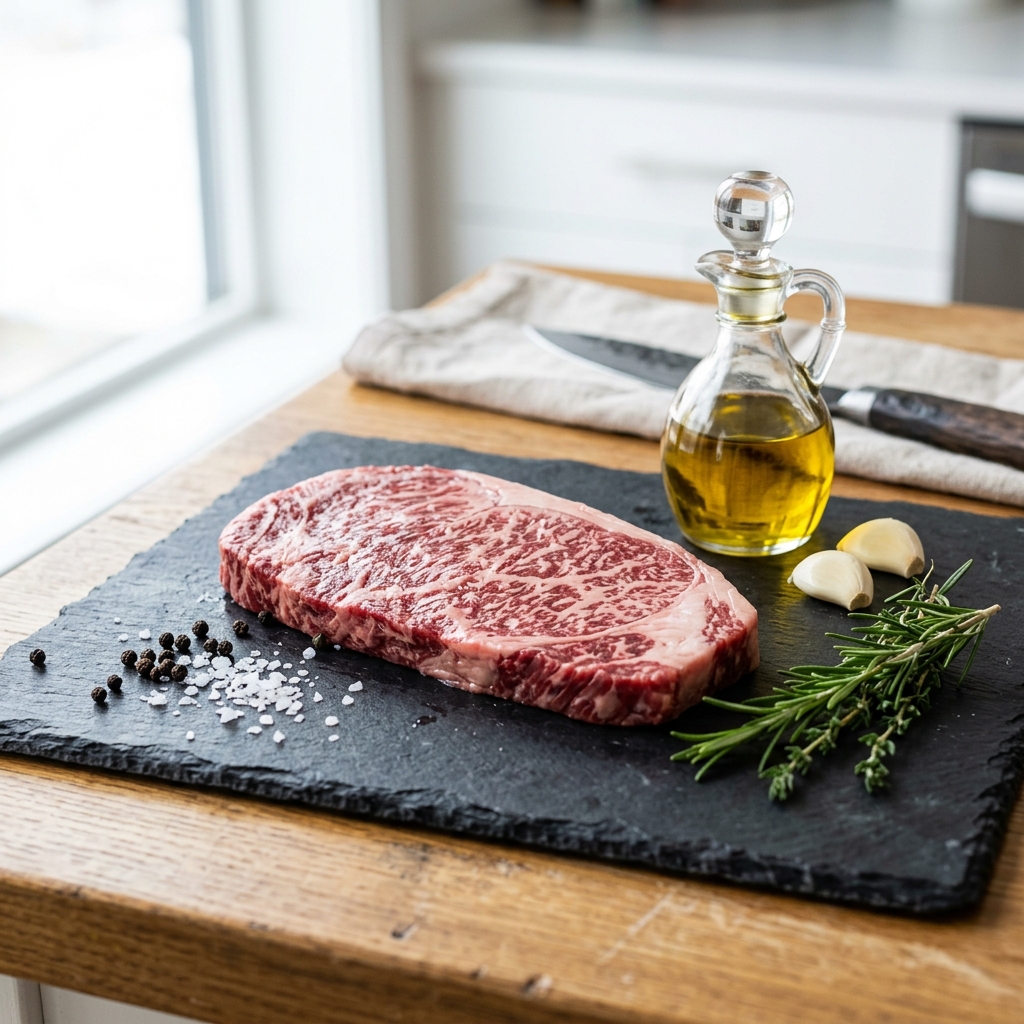
The muscle tissue of high-grade Japanese Wagyu (particularly the purebred Kuroge Washu) is exceptionally rich in free amino acids, specifically L-glutamate ($C_5H_9NO_4$). Glutamate is the primary chemical ligand that triggers the T1R1+T1R3 receptor.
During the standard 30-month rearing period and subsequent dry or wet aging phases, muscle proteins undergo continuous enzymatic proteolysis. Endogenous calpain and cathepsin enzymes break down complex proteins into their component peptides and free amino acids. When the beef is cooked, these amino acids are released, presenting an abundant supply of L-glutamate to the palate.
However, L-glutamate alone only partially activates the Venus flytrap-like binding domain of the T1R1+T1R3 heterodimer. To achieve full, locked activation, the receptor requires the presence of purine ribonucleotides: Disodium Inosinate (IMP) or Disodium Guanylate (GMP).
The Synergy Formula: Nucleotide Lock-and-Key Mechanics
When a nucleotide such as IMP binds to the adjacent pocket of the T1R1+T1R3 receptor, it induces a conformational change. This physical shift "locks" the Venus flytrap domain closed around the L-glutamate molecule, dramatically slowing down its dissociation rate.
The mathematical relationship of this taste synergy is represented by the classic organoleptic equation:
$$Y = X_1 + X_2 + k(X_1 \cdot X_2)$$
Where:
- $Y$ is the total perceived umami intensity.
- $X_1$ is the concentration of L-glutamate.
- $X_2$ is the concentration of the synergistic nucleotide (IMP or GMP).
- $k$ is a constant representing the synergistic factor (typically extremely high, around 1,200 for human taste receptors).
Because of this multiplier ($k(X_1 \cdot X_2)$), even trace amounts of IMP or GMP paired with Wagyu's rich glutamate supply can increase the perceived savory depth by 8 to 12 times.
| Seasoning / Condiment | Dominant Synergistic Compound | Molecular Function | Taste Impact |
|---|---|---|---|
| Aged Soy Sauce (Shoyu) | Glutamic acid, Aspartic acid & trace IMP | Provides supplementary free amino acids and sodium ions ($Na^+$) that enhance overall receptor sensitivity. | Deepens baseline savory notes, balances sweet fat. |
| Fermented Miso Paste | L-Glutamate, Disodium Guanylate (GMP) | Fermentation by Aspergillus oryzae yields dense GMP, which targets the T1R1 pocket directly. | Long-lasting, mouth-coating fullness (Koku). |
| Katsuobushi (Bonito Flakes) | Disodium Inosinate (IMP) | Pure animal-derived ribonucleotide that acts as the ultimate lock-and-key partner for Wagyu's glutamate. | Exploding, clean front-palette umami. |
The Wasabi Counterbalance: Volatile Organosulfur Dynamics
No discussion of premium Wagyu pairing is complete without analyzing the biological action of fresh Hon-Wasabi (Eutrema japonicum).
Unlike chilies, which contain capsaicin (an oil-soluble alkaloid that binds to TRPV1 heat receptors on the tongue and causes long-lasting pain), wasabi's heat is driven by Allyl Isothiocyanate (AITC) ($C_4H_5NS$). AITC is a highly volatile organosulfur compound that does not target the tongue's taste buds. Instead, it vaporizes in the mouth and travels retronasally to stimulate the TRPA1 (transient receptor potential ankyrin 1) channels in the nasal cavity, producing a sharp, clean clearing sensation that quickly dissipates.
When wasabi is paired with heavily marbled A5 Wagyu, a fascinating lipid-pairing reaction occurs:
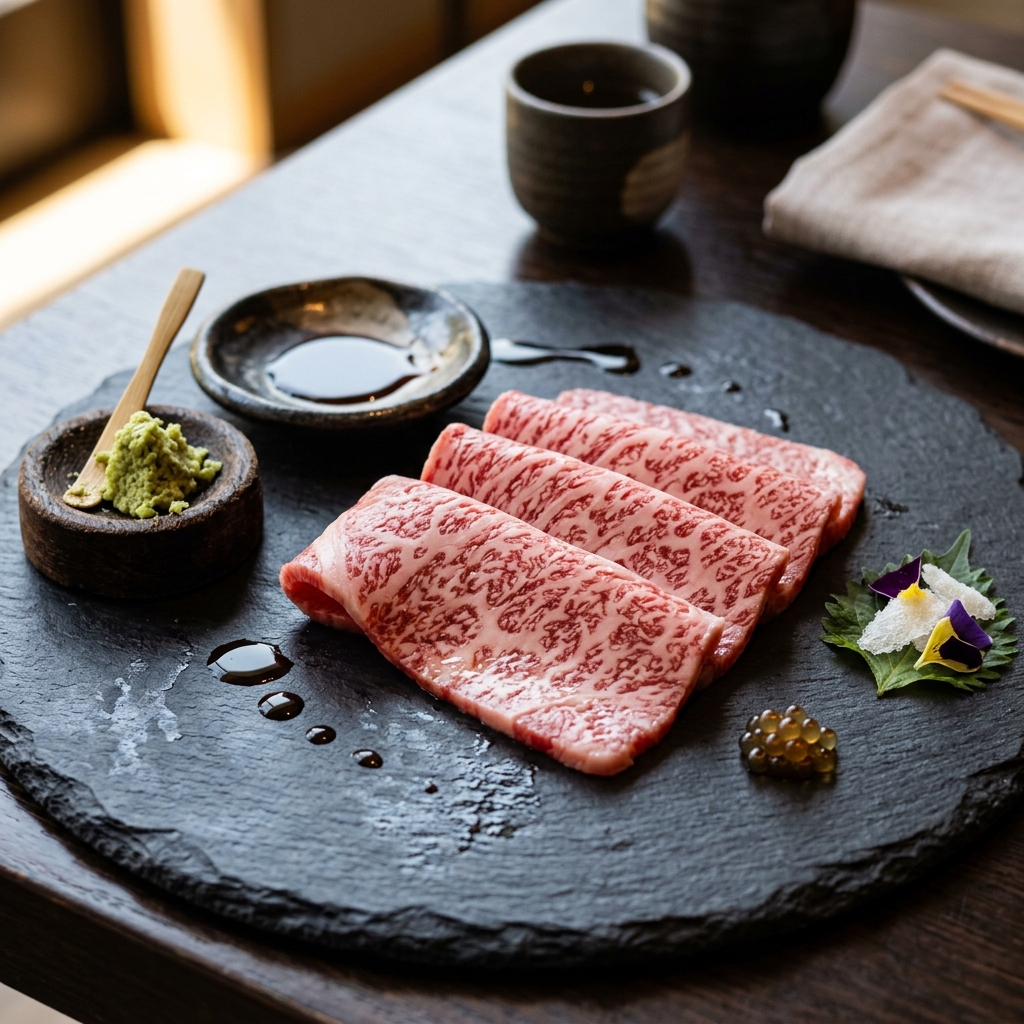
- Lipid Solubilization: AITC is highly lipophilic (fat-soluble). When chewed together with Wagyu, the copious amount of low-melting-point monounsaturated fatty acids (oleic acid) coats the wasabi particles.
- Vapor Suppression: The liquefied Wagyu fat acts as a physical solvent, dissolving the AITC and trapping it within the fat emulsion. This prevents the AITC from instantly vaporizing and rushing to the nasal cavity.
- Sweet Sensation: With the harsh nasal sting suppressed, the secondary flavor compounds of the wasabi—specifically its natural sugars and green, herbal aldehydes—are revealed. The wasabi tastes remarkably sweet, clean, and refreshing, while simultaneously cutting through the heavy richness of the Wagyu lipids.
This is the ultimate expression of molecular gastronomy: using biological fats to chemically buffer volatile spices, creating a balanced, harmonious, and highly elevated dining experience.
Kazuya Akanuma
Wagyu Specialist | Restaurant Consultant | Serial EntrepreneurA seasoned restaurateur and business owner who has successfully founded and managed premier Sushi venues, traditional Yakiniku grills, and high-end Cafe Bars in Tokyo. As an active restaurant consultant, he possesses a rare, 360-degree understanding of the culinary market. Fueled by a relentless passion for culinary craft, he dines at over 600 establishments annually—ranging from ultra-exclusive, reservation-only masterpieces to legendary neighborhood ramen shops. He leverages his insider access and decades of industry experience to guide global travelers to the absolute summit of authentic Japanese dining.
Related Articles
The Physics of the "Teppanyaki" Surface: Chromium-Steel Thermodynamics, the Leidenfrost Effect, and Wagyu Lipid Liquefaction
The Chemistry of Charcoal: Binchotan Far-Infrared Thermodynamics vs. Gas & Electric Grills