The Physics of Melting Points: Why Premium Wagyu Fat Melts in Your Palm and Never Feels Heavy
Deconstruct the science of oleic acid in Wagyu fat. Discover why premium fat melts below 25°C, creates a signature mouthfeel, and is chemically distinct from Western beef.
The Physics of Melting Points: Why Premium Wagyu Fat Melts in Your Palm and Never Feels Heavy
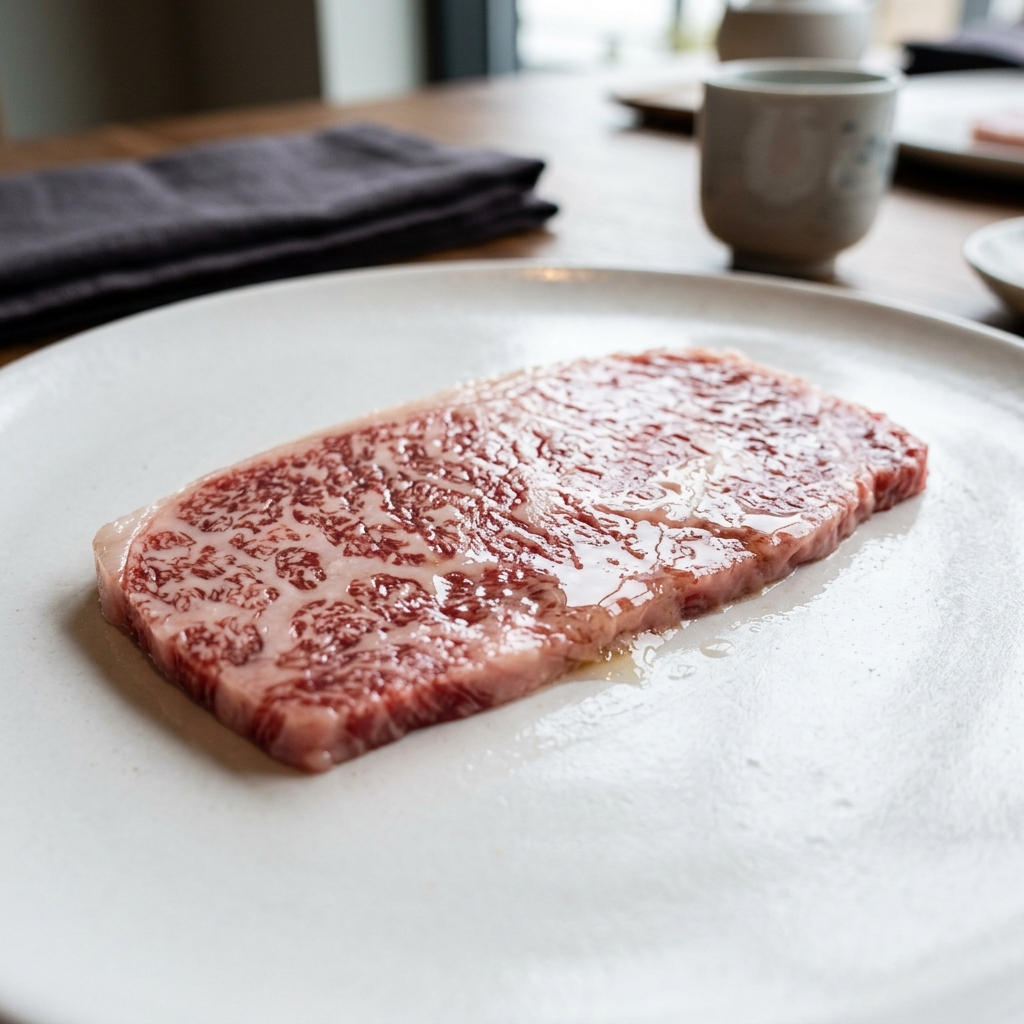
If you place a slice of raw A5 Wagyu sirloin directly onto your bare palm, something extraordinary happens. Within seconds, without any heat source other than your own body, the pearlescent white ribbons of fat will begin to turn translucent. A glossy, aromatic oil will pool in the creases of your hand, sliding effortlessly across your skin.
This is not a parlor trick; it is a manifestation of pure molecular physics.
In contrast, if you were to do the same with a premium USDA Prime Angus steak, the fat would remain completely solid, waxy, and cold. The reason for this startling disparity lies in the microscopic world of fatty acids, the molecular structure of cellular membranes, and a chemical compound known as oleic acid.
Understanding the melting point of Wagyu fat is not just an academic exercise—it is the key to understanding why Wagyu possesses its legendary buttery texture, its unique sweet aroma, and why, despite its extreme richness, it never feels "heavy" in your stomach.
Chapter 1: The Chemistry of Saturated vs. Unsaturated Fats
To understand why Wagyu fat behaves so differently from Western beef fat, we must look at the carbon bonds that make up lipids. All animal fats are composed of triglycerides—three fatty acid chains bound to a glycerol backbone. These fatty acids are classified into two broad categories:
1. Saturated Fatty Acids (SFAs)
Saturated fats have carbon atoms that are fully "saturated" with hydrogen atoms, meaning they only contain single bonds between carbon atoms. These straight, uniform chains can pack together tightly, like bricks in a wall. Because of this dense packing, saturated fats have high molecular stability and, consequently, high melting points.
- Stearic Acid (melting point: 69.3°C / 156.7°F) and Palmitic Acid (melting point: 62.9°C / 145.2°F) are the primary saturated fats found in conventional beef. This is why Western steak fat remains solid even when warm and requires intense heat to render.
2. Monounsaturated Fatty Acids (MUFAs)
Unsaturated fats contain one or more double bonds between carbon atoms. This double bond introduces a physical "kink" or bend in the carbon chain. Because of this kink, the molecules cannot pack tightly together; they remain fluid and loose, much like olive oil.
- Oleic Acid is a monounsaturated fatty acid (specifically an Omega-9). Because of its bent structure, its melting point is an astonishingly low 13°C to 16°C (55.4°F to 60.8°F).
Chapter 2: The Oleic Acid Phenomenon in Wagyu
While standard Western grain-fed cattle typically have a fat composition containing roughly 35% to 40% monounsaturated fatty acids, purebred Japanese Black Wagyu (Kuroge Washu) is genetically predisposed to produce far higher ratios.
High-grade Wagyu frequently boasts a monounsaturated fatty acid profile exceeding 55% to 65% of its total lipid content, with the vast majority of that being pure oleic acid.
Fatty Acid Composition Comparison:
┌─────────────────────────┬──────────────────────┐
│ Western Angus Beef      │ Wagyu (Kuroge Washu) │
├─────────────────────────┼──────────────────────┤
│ MUFA: ~38%              │ MUFA: 55% - 65%+     │
│ SFA: ~62%               │ SFA: 35% - 45%       │
│ Melting Point: ~40°C    │ Melting Point: <25°C │
└─────────────────────────┴──────────────────────┘
This drastic shift in chemical composition completely alters the physical state of the beef's fat. The melting point of standard beef fat sits between 37°C and 42°C (98.6°F to 107.6°F)—which is above the normal human body temperature (37°C / 98.6°F).
However, the melting point of premium Wagyu fat drops precipitously, often sitting between 18°C and 25°C (64.4°F to 77°F).
Because human skin temperature typically hovers around 33°C (91.4°F), raw Wagyu fat will literally liquefy in your hand. More importantly, when you place a piece of grilled Wagyu in your mouth, the fat does not need to be chewed; the ambient heat of your palate (37°C) instantly vaporizes the fat, releasing a rush of rich, buttery liquid that floods your taste receptors.
Chapter 3: Why Wagyu Never Feels "Heavy" in Your Stomach
One of the greatest paradoxes of dining on Wagyu is that despite eating meat that is physically composed of up to 40% fat by weight, you do not feel the greasy, sluggish fullness that often follows a massive American ribeye.
This difference is rooted in how our digestive system processes fats of different melting points.
When you consume Western beef with a high melting point (around 40°C), the fat enters your stomach and small intestine in a semi-solid or highly viscous state. Your body must work incredibly hard, secreting massive amounts of bile and lipase enzymes to emulsify and break down these solid, waxy fats. This prolonged digestion keeps the stomach active for hours, drawing blood flow away from your brain and muscles, leading to the infamous "food coma."
Wagyu fat, being completely liquid at body temperature, enters the digestive tract already fully rendered. Because it is highly fluid, lipase enzymes can easily access the molecular bonds, leading to rapid emulsification and exceptionally fast digestion.
Furthermore, oleic acid is highly bioactive and has been shown to:
- Reduce LDL (Bad) Cholesterol: Unlike saturated fats which raise bad cholesterol, oleic acid maintains or elevates HDL (good) cholesterol, promoting cardiovascular health.
- Lower Blood Pressure: Oleic acid incorporates into cell membranes, regulating membrane fluid physics and improving vascular blood flow.
- Prevent Plaque Formation: Due to its low melting point, Wagyu fat does not solidify in the bloodstream, avoiding the artery-clogging risks associated with heavy saturated fats.
When you eat premium Wagyu, you are not consuming heavy grease; you are essentially consuming a highly refined, warm, aromatic liquid gold that is chemically closer to extra virgin olive oil than to standard beef tallow.

Kazuya Akanuma
Wagyu Specialist | Restaurant Consultant | Serial EntrepreneurA seasoned restaurateur and business owner who has successfully founded and managed premier Sushi venues, traditional Yakiniku grills, and high-end Cafe Bars in Tokyo. As an active restaurant consultant, he possesses a rare, 360-degree understanding of the culinary market. Fueled by a relentless passion for culinary craft, he dines at over 600 establishments annually—ranging from ultra-exclusive, reservation-only masterpieces to legendary neighborhood ramen shops. He leverages his insider access and decades of industry experience to guide global travelers to the absolute summit of authentic Japanese dining.
Related Articles
The Physics of the "Teppanyaki" Surface: Chromium-Steel Thermodynamics, the Leidenfrost Effect, and Wagyu Lipid Liquefaction
The Chemistry of "Umami Synergy": How Wagyu Glutamates and Fermented Condiments Trigger Exponential Taste Receptors