Beyond A5: How Monounsaturated Fatty Acids (MUFA) and Aroma Profiling Form the Next-Gen Wagyu Grading System
Moving beyond visual marbling (BMS). Explore the next-generation quality indexes emerging in Japan, including Near-Infrared oleic acid testing and GC-MS aroma profiling.
Beyond A5: How Monounsaturated Fatty Acids (MUFA) and Aroma Profiling Form the Next-Gen Wagyu Grading System
For decades, the two characters "A5" have represented the absolute summit of culinary excellence. It is the gold standard that every premium restaurant in the world fights to put on its menu, and every diner expects to pay a premium for.
But inside Japan's most elite agricultural circles, a quiet consensus has emerged: the A5 grading system is outdated, and it does not measure how the beef actually tastes.
The classic grading system, created in the 1980s by the Japan Meat Grading Association (JMGA), is entirely visual. It measures the sheer quantity of white fat inside the meat (the Beef Marbling Standard, or BMS) but completely ignores the chemical quality of that fat, the concentration of savory amino acids, and the aroma of the cooked beef.
As modern gourmands demand deeper flavor rather than just heavy grease, Japan is pioneered a new, highly scientific grading frontier that moves far beyond the A5 label to evaluate Wagyu based on monounsaturated fatty acids (MUFA) and gas chromatography aroma profiling.
Chapter 1: The Structural Limits of Visual Grading
To understand why a new system is necessary, we must look at how an official JMGA grader evaluates a carcass.
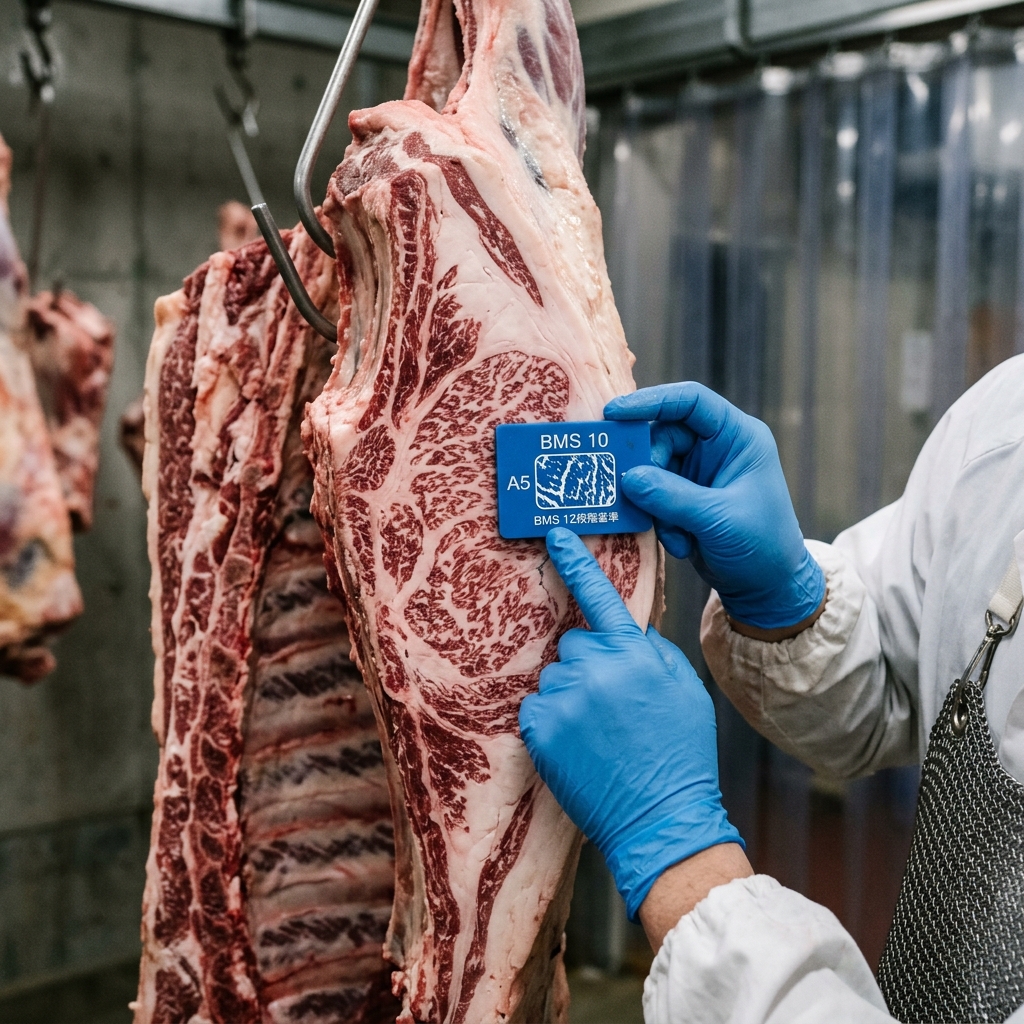
Between the 6th and 7th rib of a slaughtered cow, a certified grader stands with a flashlight and a plastic grid.
They grade the meat on a 1-to-5 scale based on four visual standards: marbling, meat color, firmness, and fat luster.
Visual Grading vs. Chemical Reality:
┌───────────────────────────┬───────────────────────────┐
│ Visual Standard (A5/BMS)  │ Chemical Reality (Taste)  │
├───────────────────────────┼───────────────────────────┤
│ Volume of fat marbling    │ Ratio of Oleic Acid       │
│ (Are the white dots big?) │ (Is the fat waxy or oily?)│
├───────────────────────────┼───────────────────────────┤
│ Color of the meat         │ Free Glutamic Acid        │
│ (Is it bright cherry red?)│ (Does it have high umami?)│
├───────────────────────────┼───────────────────────────┤
│ Luster of the fat         │ Volatilized Lactones      │
│ (Does the fat look shiny?)│ (Does it smell like peach?)│
└───────────────────────────┴───────────────────────────┘
Crucially, not a single slice of meat is ever tasted or chemically tested during this process.
This creates two massive blind spots:
- The "Waxy" A5: If a cow is genetically predisposed to produce waxy, high-melting-point saturated stearic acids, the fat will appear solid and beautifully white. Visually, it scores a perfect BMS 12 (A5). In the mouth, however, this fat remains solid and heavy, leaving a greasy, waxy film on the palate.
- The Savory A4: A cow might have slightly less marbling, scoring a BMS 7 (Quality Grade 4). However, it might possess exceptionally high levels of glutamic acid (umami) and an ultra-low melting point fat rich in oleic acid. Visually, it is graded an "A4". Gastronomically, it is vastly superior, sweeter, and more melting than the A5.
Chapter 2: The Fatty Acid Revolution (The MUFA Index)
To solve the waxy fat problem, Japanese prefectures have begun bypass visual grading by using high-tech Near-Infrared (NIR) Spectroscopy directly in the slaughterhouses.
These handheld spectroscopic guns shoot light waves into the fat. Within seconds, the machine analyzes the molecular vibration of the lipids, calculating the exact percentage of Monounsaturated Fatty Acids (MUFAs)—principally oleic acid.
Prefectures are now issuing custom, chemistry-backed quality certifications that sit alongside the visual A5 grade:
- Tottori Prefecture ("Tottori Wagyu 55"): Tottori was the first to introduce this system. To receive this special gold seal, the beef must not only be certified Kuroge Washu but must chemically register an oleic acid concentration of 55% or higher.
- Yamagata Prefecture (Yonezawa Beef): Yonezawa cattle must meet strict minimum oleic acid percentages, ensuring the fat melting point is physically guaranteed to sit below 20°C (68°F).
When you purchase beef with these MUFA-certified seals, you are receiving a physical guarantee that the fat is rich in heart-healthy, low-melting-point lipids that will liquefy instantly on your tongue.
Chapter 3: Gas Chromatography and Aroma Profiling
The final, most exciting frontier of Wagyu science is aroma profiling. The signature characteristic of cooked Wagyu is Wagyu-ko (Wagyu aroma)—a sweet, rich scent that is chemically similar to a combination of coconut, peach, and melted butter.
Scientists have discovered that this aroma is generated by organic compounds called lactones (primarily $\gamma$-nonalactone and $\gamma$-decalactone) and specific esters.
To measure this, elite Japanese research labs are using Gas Chromatography-Mass Spectrometry (GC-MS):
- Vapor Capture: Slices of beef are cooked in a sealed, temperature-controlled thermal chamber. The vapors released are sucked into a glass tube.
- Chemical Separation: The gas chromatograph separates the complex vapor into its individual aromatic molecules.
- Molecular Mass Identification: The mass spectrometer measures the precise concentration of sweet lactones compared to bitter or metallic compounds.
By profiling the volatilized aroma molecules, researchers can assign a "Flavor Quality Score" to the beef.
This science is already beginning to influence prestigious national cattle competitions (known as the "Wagyu Olympics").
In the near future, the ultimate sign of a luxury steak will not be a visual certificate of A5 marbling, but a digital readout showing a guaranteed low melting point of 18°C and a high lactone count—assuring a sensory experience that is verified by the laws of chemistry.
Kazuya Akanuma
Wagyu Specialist | Restaurant Consultant | Serial EntrepreneurA seasoned restaurateur and business owner who has successfully founded and managed premier Sushi venues, traditional Yakiniku grills, and high-end Cafe Bars in Tokyo. As an active restaurant consultant, he possesses a rare, 360-degree understanding of the culinary market. Fueled by a relentless passion for culinary craft, he dines at over 600 establishments annually—ranging from ultra-exclusive, reservation-only masterpieces to legendary neighborhood ramen shops. He leverages his insider access and decades of industry experience to guide global travelers to the absolute summit of authentic Japanese dining.
Related Articles
The Physics of the "Teppanyaki" Surface: Chromium-Steel Thermodynamics, the Leidenfrost Effect, and Wagyu Lipid Liquefaction
The Chemistry of "Umami Synergy": How Wagyu Glutamates and Fermented Condiments Trigger Exponential Taste Receptors