The Art of the 1mm Slice: How Master Butchers Read Grain Angles to Alter Mastication and Texture
Why thin slicing is the ultimate expression of Wagyu dining. Deconstruct the physical relationship between grain angles, chew resistance, and rapid flavor delivery.
The Art of the 1mm Slice: How Master Butchers Read Grain Angles to Alter Mastication and Texture
To the Western eye, the way beef is prepared in Japan can be shocking.
In a traditional American or European steakhouse, luxury is defined by the thickness of the cut. A colossal 2-inch-thick Porterhouse or a heavy, dense ribeye block is the gold standard.
Yet, in a high-end Tokyo Yakiniku, Sukiyaki, or Shabu-Shabu restaurant, you are presented with beef sliced to the precision of a surgical sheet—sometimes as thin as a single millimeter.
This is not a cost-saving measure, nor is it a simple aesthetic choice. The ultra-thin slice is a highly calculated physical and sensory tool designed to unlock the maximum potential of Japanese Wagyu.
By manipulating the thickness and the angle of the cut, Japanese master butchers manipulate the physics of mastication (chewing), the rate of fat rendering, and how flavor molecules are released in the human mouth.
Chapter 1: The Physics of Chew Resistance
To understand why Wagyu is sliced so thin, we must examine the biology of muscle tissue. Meat is composed of bundles of muscle fibers wrapped in layers of connective tissue (primarily collagen sheets called perimysium and endomysium).
When you bite into a piece of beef, your teeth must physically cut through these collagen walls and muscle bundles. The force required to do this is known as chew resistance.
Muscle Fiber Slicing Geometry:
┌───────────────────────────┬───────────────────────────┐
│ With the Grain (Parallel) │ Against the Grain (Cross) │
├───────────────────────────┼───────────────────────────┤
│ ─── ─── ─── ─── ───       │  │   │   │   │   │        │
│ ─── ─── ─── ─── ───       │  │   │   │   │   │        │
│ Fibers remain long.       │ Fibers cut into microscopic│
│ Result: Tough & Chewy.    │ segments. Melt-in-mouth.  │
└───────────────────────────┴───────────────────────────┘
Standard Western beef is relatively lean and has high chew resistance. If you were to slice standard beef to 1mm thickness, it would cook into a dry, paper-like leather because the lean proteins would quickly contract and dry out.
Wagyu, however, is a physical matrix of highly delicate intramuscular fat suspended within a fine protein web. When sliced to 1mm:
- Eliminating Chew Resistance: The structural integrity of the tough connective tissue sheets is completely shattered. The physical distance your teeth must travel to sever the fibers is reduced to practically zero.
- The Tenderness Illusion: The meat does not need to be actively chewed; the simple pressing action of your tongue against the roof of your mouth is enough to collapse the physical structure of the slice.
Chapter 2: The Butcher's Geometry: Reading the Grain
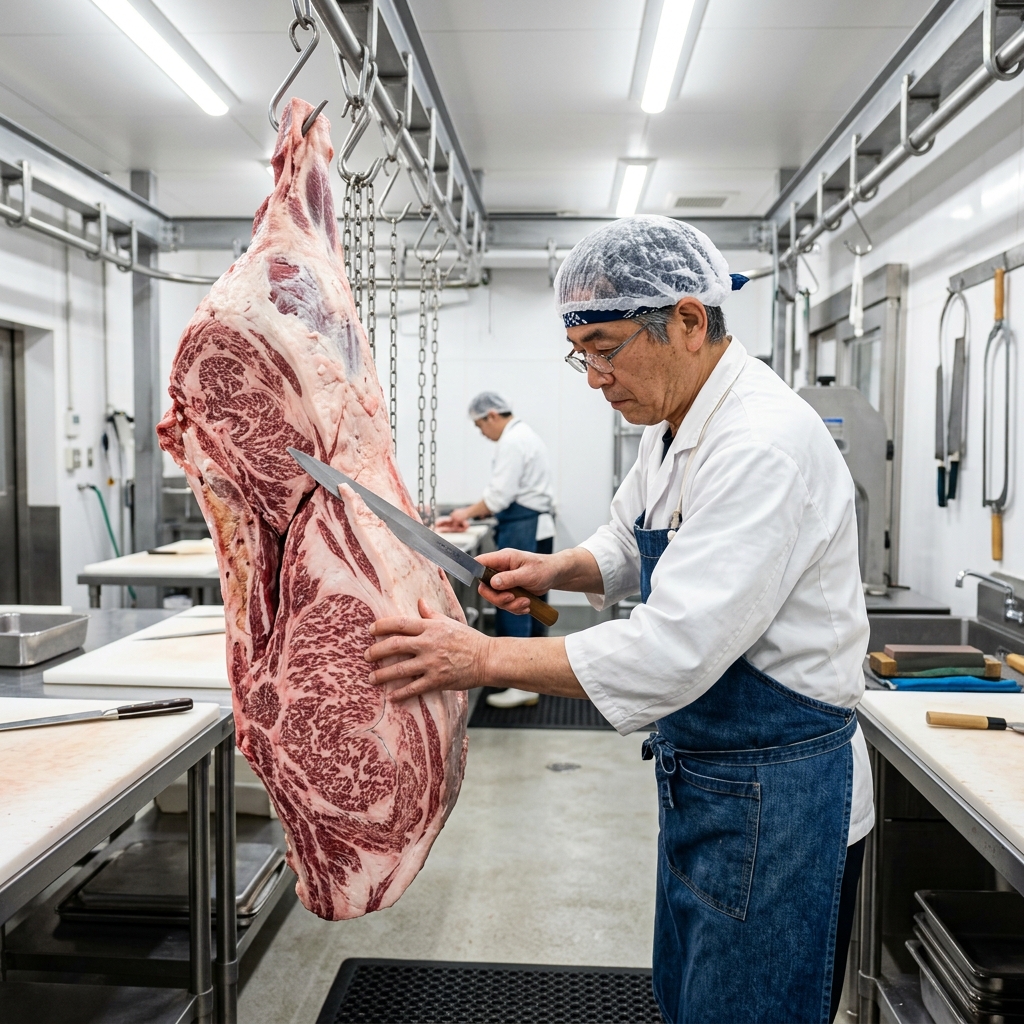
A master Wagyu butcher (Shokunin) does not simply push a block of meat through an electric slicer. Every muscle group in a cow has a unique fiber direction (grain) that changes as the muscle curves around bones and tendons.
To slice meat correctly, the butcher must read the three-dimensional geometry of the muscle fibers in real time:
- The 90-Degree Rule: The knife must always cut at a perfect 90-degree angle (perpendicular) to the direction of the muscle fibers. This cuts the long, rope-like fibers into the shortest possible microscopic segments, ensuring maximum tenderness.
- The Angle Shift: If a slice is cut even 10 degrees off-angle (obliquely), the muscle fibers remain long and elastic. When cooked, these fibers will contract, curling the slice into a cup shape and making the meat feel tough and stringy in the mouth.
- Intramuscular Fat Alignment: Slicing perpendicular to the grain ensures that the fine, delicate white lattices of fat (marbling) are cut crosswise. When heated, this fat can render uniformly across the entire surface of the slice, rather than leaving pockets of cold, unrendered solid fat.
Chapter 3: Neuro-Sensory Flavor Release
The ultimate triumph of the 1mm slice is how it interacts with the human nervous system to deliver flavor.
Flavor perception is not just a function of taste buds; it is highly dependent on surface area and temperature kinetics.
When you chew a thick chunk of steak, the flavor is released slowly. Your mouth must work hard to break down the meat, and the cool interior of the steak takes time to warm up to your body temperature.
When you place a hot, 1mm slice of grilled Wagyu onto your tongue:
- Exponential Surface Area: The surface area of the beef in contact with your taste buds is exponentially larger than that of a thick steak cube.
- Instant Thermal Transfer: Because the slice is incredibly thin, the heat of your mouth (37°C / 98.6°F) instantly penetrates the entire thickness of the meat.
- The Oleic Acid Flash: As the temperature of the slice rises instantly to body temperature, the high concentration of oleic acid in the Wagyu fat flashes into a warm liquid oil.
- Neuro-Sensory Saturation: This warm, aromatic oil floods your entire oral cavity, coating your taste receptors in a highly concentrated emulsion of glutamate (umami) and sweet lactones.
This sends a massive, immediate signal to your brain's reward center, creating the legendary, euphoric "melt-in-your-mouth" sensation that has made Japanese Wagyu a global culinary icon.

Kazuya Akanuma
Wagyu Specialist | Restaurant Consultant | Serial EntrepreneurA seasoned restaurateur and business owner who has successfully founded and managed premier Sushi venues, traditional Yakiniku grills, and high-end Cafe Bars in Tokyo. As an active restaurant consultant, he possesses a rare, 360-degree understanding of the culinary market. Fueled by a relentless passion for culinary craft, he dines at over 600 establishments annually—ranging from ultra-exclusive, reservation-only masterpieces to legendary neighborhood ramen shops. He leverages his insider access and decades of industry experience to guide global travelers to the absolute summit of authentic Japanese dining.
Related Articles
The Samurai Feast: Sengoku Military Rations, Edo Evasion Codes, and the Secret Origin of Medicinal Beef

The Forgotten Breeds: Restoring the Sacred Shorthorn (Nihon Tankaku-shu) and Polled (Nihon Mukaku-shu) Genetics