Olive Wagyu
The Mediterranean miracle of the Seto Inland Sea. By feeding cattle the toasted pomace of local olives, Kagawa Prefecture created an incredibly rare, healthy Wagyu with unmatched levels of light, melt-in-the-mouth oleic acid.
Olive Wagyu: The Mediterranean Miracle of the Seto Inland Sea
When connoisseurs discuss the diet of premium Japanese Wagyu, the conversation typically revolves around high-quality grains, roasted soybeans, and premium rice straw (such as the Sasanishiki straw fed to Sendai Beef). The goal is almost always to increase the volume and sweetness of the intramuscular fat.
However, on a small, sun-drenched island in the Seto Inland Sea, local farmers embarked on a radical, desperate agricultural experiment that completely revolutionized the concept of Wagyu fat. They didn't just change the diet of the cattle; they accidentally altered the fundamental chemical composition of the meat itself.
This is the story of Olive Wagyu (オリーブ牛 - pronounced Olive-gyu) from Kagawa Prefecture.
Often referred to simply as "Sanuki Beef" in the past, the modern iteration of Olive Wagyu is arguably the rarest, most unique, and most scientifically fascinating brand of beef on the planet. It is the result of a brilliant solution to a local industrial waste problem, transforming a discarded byproduct into the secret ingredient for the healthiest, lightest, and most "melt-in-the-mouth" Wagyu ever produced.
Chapter 1: The Island of Olives
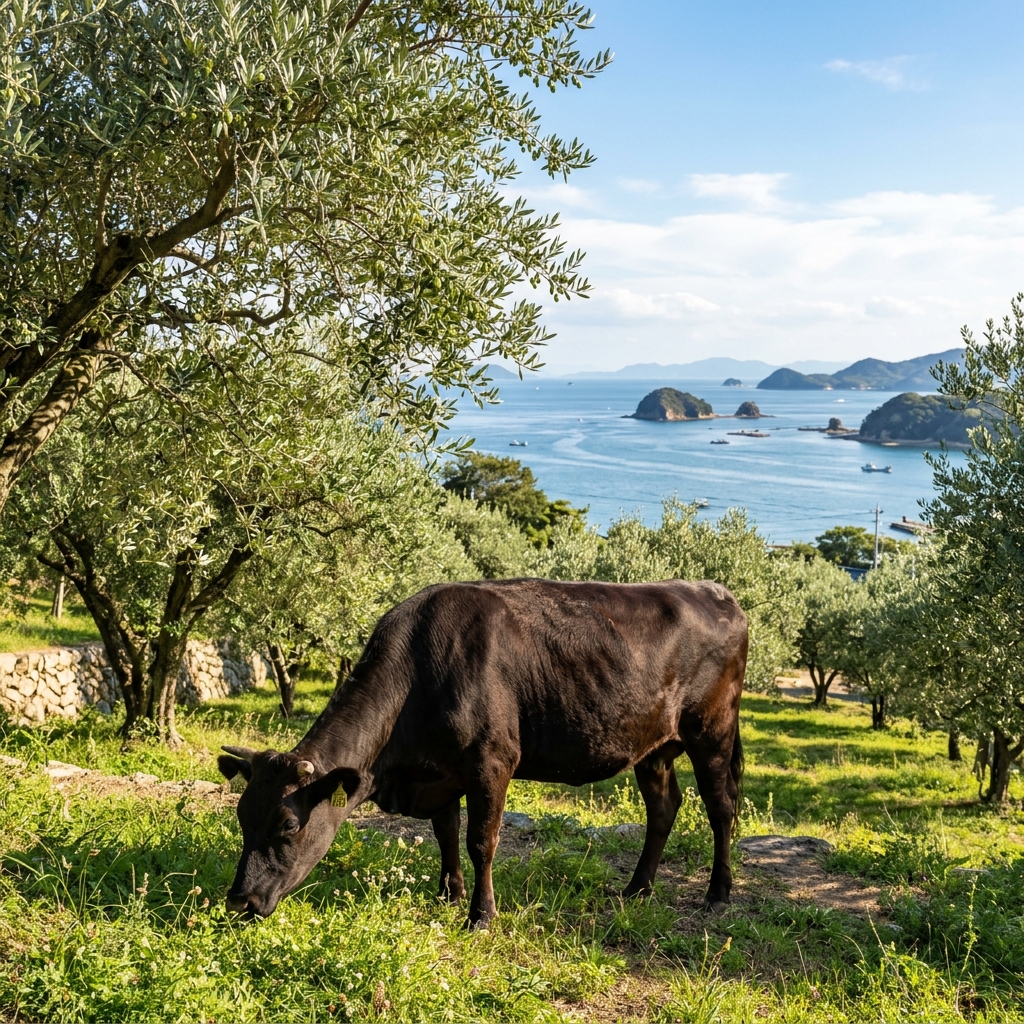
To understand Olive Wagyu, one must first understand its incredibly unique terroir. The story begins on Shodoshima (小豆島), the second-largest island in the Seto Inland Sea, belonging to Kagawa Prefecture.
Shodoshima does not look or feel like the rest of Japan. Protected by the surrounding landmasses of Honshu and Shikoku, the island experiences a distinctly "Mediterranean" climate. It is warm, dry, incredibly sunny, and largely immune to the devastating typhoons that ravage the Pacific coast.
Because of this unique Mediterranean microclimate, Shodoshima is famous throughout Japan for one very specific, un-Japanese crop: Olives. It was the very first place in Japan to successfully cultivate olives over a century ago, and it remains the undisputed capital of Japanese olive oil production.
For decades, the island's economy thrived on the production of premium, cold-pressed extra virgin olive oil. However, this booming industry created a massive, highly problematic byproduct.
Chapter 2: The Industrial Waste Problem
To produce olive oil, the raw olives are crushed and pressed. The resulting liquid is separated into oil and water. But what remains is a massive amount of solid organic waste: the crushed skins, pits, and fibrous pulp of the olives. This is known as "olive lees" or "olive pomace."
For a long time, this pomace was a major headache for the island. It was heavy, wet, and highly astringent (bitter) due to the presence of natural polyphenols and oleuropein. It was essentially industrial waste, and disposing of it was difficult and expensive. It couldn't simply be dumped, and it was too bitter to be used as standard animal feed.
The Desperate Experiment of Masaki Ishii
Enter Masaki Ishii, a local Wagyu farmer on Shodoshima. In 2006, Ishii looked at the massive piles of discarded olive pomace and had a revolutionary thought. He knew that olives were incredibly healthy for humans, packed with antioxidants and healthy monounsaturated fats. If he could somehow convince his cattle to eat the pomace, it might solve the island's waste problem and simultaneously improve the health of his herd.
However, his initial attempts were disastrous. The raw olive pomace was so overwhelmingly bitter that the cattle flatly refused to eat it. They would literally push it out of their troughs.
Ishii spent years experimenting. He tried drying it, boiling it, and mixing it with other feeds, but nothing worked. Finally, he discovered a brilliant, natural solution: Toasting.
By slowly toasting the olive pomace over a low heat for hours, Ishii was able to caramelize the natural sugars in the pulp, completely neutralizing the bitter astringency and transforming the pomace into a sweet, highly aromatic, almost malt-like superfood.
When he finally presented the toasted olive pomace to his cattle, they devoured it. This was the birth of Olive Wagyu.
Chapter 3: The Science of Oleic Acid
When the first batch of cattle fed on the toasted olive pomace was finally slaughtered and graded, the farmers and scientists of Kagawa Prefecture were absolutely astounded by the results.
The olive diet had not just improved the health of the cattle; it had fundamentally altered the chemical composition of their intramuscular fat.
The Ultimate Healthy Fat
Olives are famously rich in Oleic Acid (a heart-healthy monounsaturated omega-9 fatty acid). When the cattle consumed massive amounts of the toasted olive pomace during their final fattening phase, their bodies absorbed this oleic acid and deposited it directly into their marbling.
Standard Japanese Black Wagyu already possesses a naturally high level of oleic acid compared to Western beef (which is why Wagyu fat melts so easily). However, scientific testing revealed that Olive Wagyu possessed an unprecedented, off-the-charts level of oleic acid, significantly higher than even the most famous A5 brands from the mainland.
This massive infusion of oleic acid had two profound, magical effects on the meat:
- Extreme Melting Point: The melting point of the fat dropped dramatically. Olive Wagyu fat practically melts at room temperature. It is so volatile that if you press a piece of the raw fat between your fingers, it will instantly liquefy into a clear, fragrant oil.
- The "Lightness" Factor: Highly marbled Wagyu (like A5 Kobe or Sendai) is notoriously heavy. Most people can only eat a small amount before experiencing "fat fatigue." Olive Wagyu completely bypassed this problem. Because the fat is so heavily composed of monounsaturated oleic acid, it is incredibly "light" and non-greasy on the palate. You can eat a massive steak of highly marbled Olive Wagyu and walk away feeling completely refreshed, without the heavy, cloying feeling associated with standard Wagyu.
Chapter 4: The Extreme Rarity of the Brand
Because the production of Olive Wagyu is fundamentally tied to the physical byproduct of the Shodoshima olive oil industry, the supply is inherently, aggressively bottlenecked.
You cannot simply buy "olive feed" and raise Olive Wagyu in Hokkaido or Tokyo. The cattle must be raised by certified farmers in Kagawa Prefecture, and they must be fed the specific toasted olive pomace generated by the local island olive harvest.
Furthermore, to be certified as true "Olive Wagyu" (Sanuki Kuroge Washu), the carcass must be officially graded and verified to contain a legally mandated, exceptionally high minimum percentage of oleic acid.
Due to these strict geographical and dietary limitations, only a few thousand head of Olive Wagyu are produced each year, making it significantly rarer than Kobe, Matsusaka, or Omi Beef. It is a true micro-brand, highly sought after by health-conscious gourmands and elite chefs across the globe who prize its unique, buttery-light flavor profile.
Chapter 5: The Culinary Experience – The Caramel Crust
Because the fat of Olive Wagyu is so completely unique, cooking it requires a slight adjustment in technique to fully appreciate its qualities.
The Sweet Scent of Olives
When Olive Wagyu hits a hot pan, something remarkable happens. The incredibly volatile, oleic-acid-rich fat begins to render instantly, releasing an aroma that is distinctly different from standard Wagyu. It does not smell heavy or overly beefy; instead, it releases a remarkably sweet, almost caramelized scent, with very faint, subtle, nutty undertones reminiscent of the toasted olive pomace they consumed.
The Perfect Olive Wagyu Steak
To cook a perfect Olive Wagyu steak, one must act quickly. Because the fat melts so rapidly, leaving the meat over the heat for too long will cause all the precious oleic acid to render out into the pan, leaving the meat dry.
The ideal preparation is a rapid, scorching-hot sear on a heavy cast-iron skillet or Teppanyaki griddle to create a quick Maillard reaction crust, locking the liquid gold inside. The interior should be served rare. When you bite into the steak, the contrast is mind-bending: you experience the intense, visual marbling of an A5 Wagyu, but the actual physical sensation is incredibly light, buttery, and refreshing. It is arguably the only heavily marbled Wagyu in the world that leaves the palate feeling clean.
Chapter 6: The Ultimate Contrast – The Lightest Fat vs. The Heaviest Meat
Olive Wagyu represents the absolute zenith of "healthy," ultra-light, modified Wagyu fat. By solving an industrial waste problem with toasted olive pomace, the farmers of Kagawa created a magical meat that possesses all the visual beauty of marbling with none of the heavy, greasy drawbacks. It is the ultimate victory of diet over density.
However, if Olive Wagyu is the ultimate expression of modified, ultra-light fat, it presents a fascinating culinary question. What if you want to experience the exact opposite? What if you don't want light, melting, modified fat, but rather the heavy, wild, unadulterated power of ancient meat?
Experience the Ultimate Contrast in Tokyo Olive Wagyu is a modern miracle, offering the lightest, healthiest, and most refreshing oleic-acid fat in the Wagyu world. But if you wish to experience the absolute opposite philosophy—the robust, historical roots of Japanese cattle that reject modern dietary modifications—you must look to the deep south.
Ibusana Beef, raised exclusively in Miyazaki Prefecture, is an incredibly rare crossbreed containing the genetics of Japan's oldest purebred, the Takenotani Tsurugyu. Unlike Olive Wagyu, which uses a specialized diet to create ultra-light fat, Ibusana completely ignores fat. Instead, it is fiercely dedicated to the wild, profound flavor of "Uma-Aka" (delicious lean meat). It offers a deep, complex, mineral-rich umami and a powerful, heavy bite that no modern, fat-focused brand can replicate.
You can experience this incredibly rare, wildly meaty contrast to Olive Wagyu exclusively at Wagyu Yakiniku Ibusana in Tokyo. Reserve your table to taste the original, wild soul of Wagyu.
Taste Olive Wagyu in Tokyo
Experience the finest quality Wagyu directly at our curated restaurants.
Reserve Yakiniku