Tosa Akaushi
The Phantom Red Meat of Shikoku. Accounting for just 0.1% of Japanese Wagyu, this incredibly rare Japanese Brown breed offers profound, amino-acid-rich red meat forged in the steep mountains of Kochi.
Tosa Akaushi: The Phantom Red Meat of Shikoku
When discussing the four official breeds of Wagyu, the vast majority of the conversation revolves around the Japanese Black (Kuroge Washu). However, the second most populous breed is the Japanese Brown (Kkasshoku Washu), commonly referred to as "Akaushi" (Red Cow).
When most people think of Akaushi, they immediately think of Kumamoto Prefecture, which produces the overwhelming majority of all Japanese Brown cattle. But there is another, significantly rarer sub-strain of the Japanese Brown breed. It is raised exclusively on the island of Shikoku, and it accounts for a staggering 0.1% of the total Wagyu population in Japan.
This is the Tosa Akaushi (土佐あか牛).
Raised in the incredibly steep, mountainous terrain of Kochi Prefecture (historically known as the Tosa Domain), this ultra-rare breed represents the absolute pinnacle of healthy, amino-acid-rich red meat. This comprehensive, multi-part master guide will explore the unique genetic differences between Tosa and Kumamoto Akaushi, the brutal but beautiful terroir of the Shikoku mountains, the science behind its sweet red meat, and the powerful contrast it presents to the fat-obsessed Wagyu industry.
Chapter 1: The Genetics of the Tosa Strain
The history of the Tosa Akaushi is a fascinating story of regional isolation. In the late 19th and early 20th centuries, as Japan sought to increase the size of its native cattle, both Kumamoto and Kochi prefectures experimented with crossbreeding.
Kumamoto farmers crossed their native cattle primarily with Simmental (a large Swiss breed), creating a massive, robust animal. The farmers of Kochi, however, took a slightly different approach. They crossed their native "Tosa" cattle with imported Korean cattle (Hanwoo), which were highly prized for their deep red color, excellent meat quality, and strength.
The resulting "Tosa Strain" of the Japanese Brown breed is distinct from its Kumamoto cousin. While Kumamoto Akaushi is large and muscular with a solid yellowish-brown coat, the Tosa Akaushi is slightly smaller, with a richer, darker reddish-brown coat. Crucially, the Tosa Akaushi is defined by its "Ke-kuro" (毛黒 - black hair) points. Pure Tosa Akaushi must have black hair on their nose, black eyelashes, and black hooves. This visually distinguishes them as the unique, rare treasure of Kochi.
Chapter 2: The Rarity of the Phantom Cow
Because the Tosa Akaushi is raised exclusively within the borders of Kochi Prefecture, and because the local farmers prioritize strict quality control and traditional, small-scale farming over mass production, the numbers are incredibly low.
There are only a few thousand Tosa Akaushi alive at any given time, and fewer than 500 are processed for meat annually. This extreme rarity has earned it the nickname "Phantom Wagyu" (幻の和牛). It is so highly prized by local chefs and high-end restaurants in Tokyo that it is exceedingly difficult to find outside of specialized channels. When you secure a cut of Tosa Akaushi, you are eating a micro-regional delicacy that represents the very soul of Shikoku agriculture.
Chapter 3: The Brutal but Beautiful Terroir
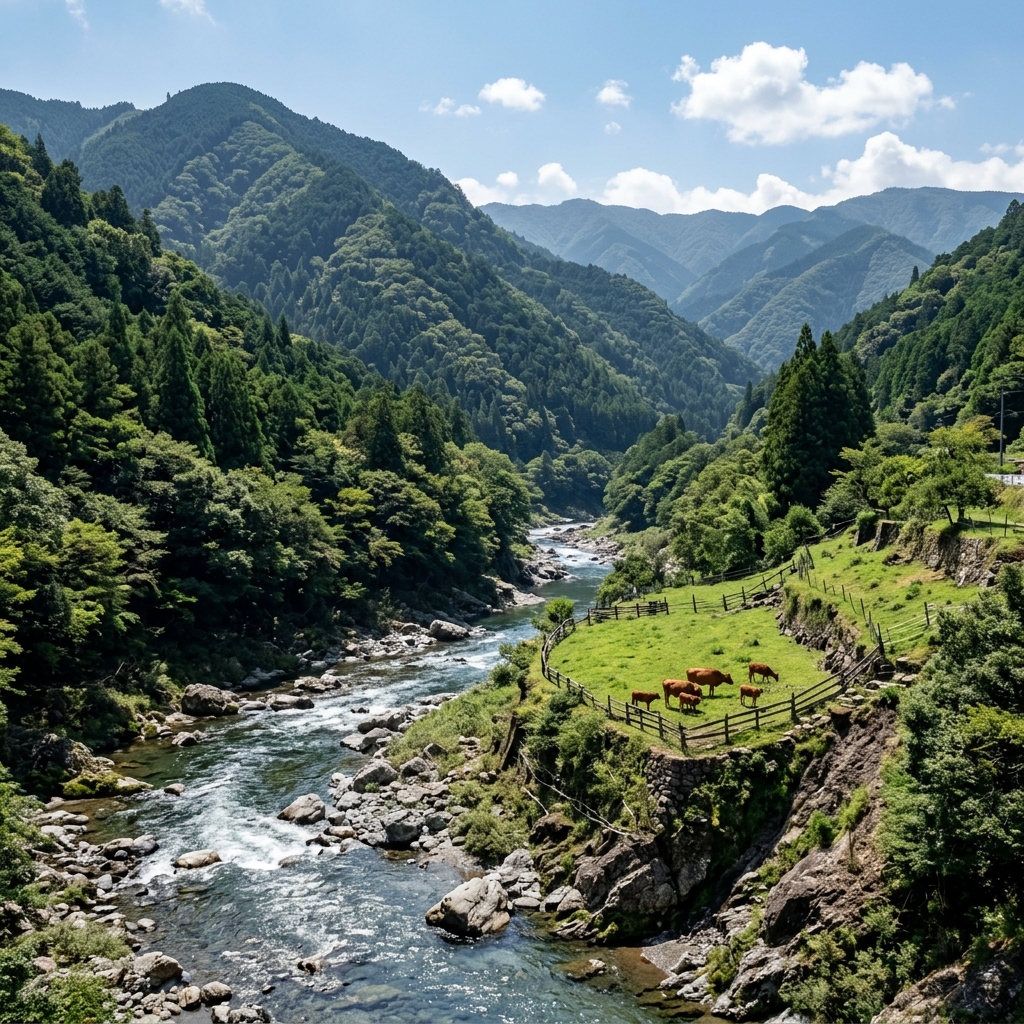
Unlike the flat, sprawling plains of Hokkaido or the massive calderas of Kumamoto, Kochi Prefecture is defined by its incredibly steep, densely forested mountains and fast-flowing, crystal-clear rivers (such as the famous Shimanto River).
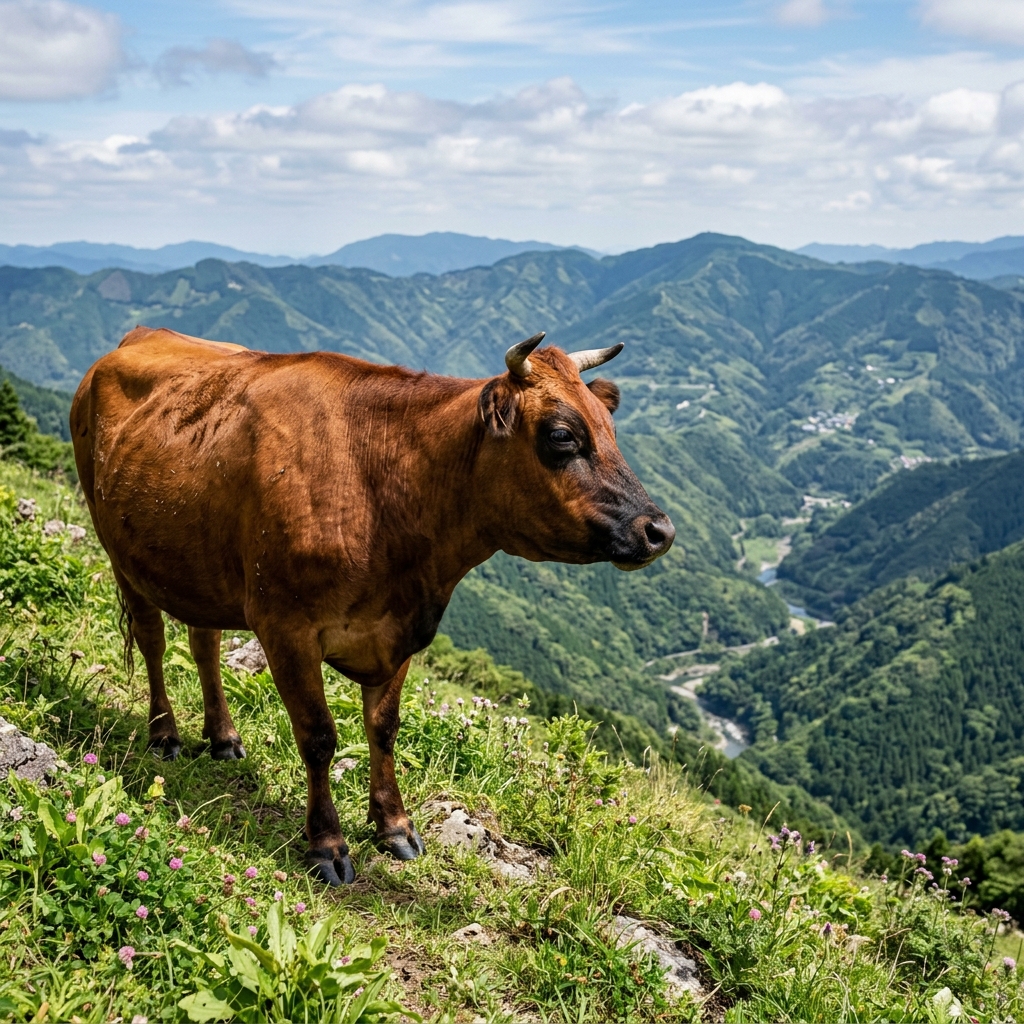
This is a difficult environment for raising large animals. The pastures are small and often located on steep inclines. However, this challenging terroir is exactly what gives the Tosa Akaushi its unique physical characteristics.
To navigate these steep mountain pastures, the cattle must be incredibly strong and agile. They naturally develop very dense, powerful muscle fibers in their legs and hindquarters. Furthermore, because Kochi experiences a mild, warm climate with abundant rainfall year-round, the cattle have access to a constant supply of rich, natural mountain grasses. This combination of vigorous daily exercise on steep terrain and a highly natural diet produces meat that is fundamentally different from cattle raised in flat, confined feedlots.
Chapter 4: The Science of Sweet Red Meat
The Wagyu industry evaluates meat based on marbling (fat). However, the true value of Tosa Akaushi lies in its "Akami" (赤身 - red meat).
If you analyze the chemical composition of Tosa Akaushi, you will find that it completely rejects the A5 fat paradigm. The meat has a significantly lower overall fat content compared to Japanese Black cattle. However, it is not simply tough, lean meat.
The red muscle fibers of the Tosa Akaushi are packed with an extraordinary concentration of Amino Acids, specifically Glutamic Acid and Inosinic Acid. These are the fundamental building blocks of "Umami." Furthermore, while the total volume of fat is low, the quality of the fat that is present is exceptional. It is finely dispersed and has a remarkably low melting point.
When you eat Tosa Akaushi, the experience is often described as a "double impact." First, the delicate, low-melting-point fat provides an initial burst of sweet, smooth flavor. Then, as you chew, the incredibly dense, amino-acid-rich red meat releases a deep, complex, and profound savory umami that lingers long after the fat has disappeared. It is the perfect balance of sweetness and power.
Chapter 5: The Culinary Experience – The Art of Roasting
Because Tosa Akaushi is defined by its incredibly high amino acid content and low volume of fat, it requires a masterful touch in the kitchen.
The Low-Temperature Roti
If you slice Tosa Akaushi thin and boil it like Shabu-Shabu, you will lose the profound depth of the red meat. If you sear it too quickly on a screaming hot pan, the lack of fat means the meat may become tough.
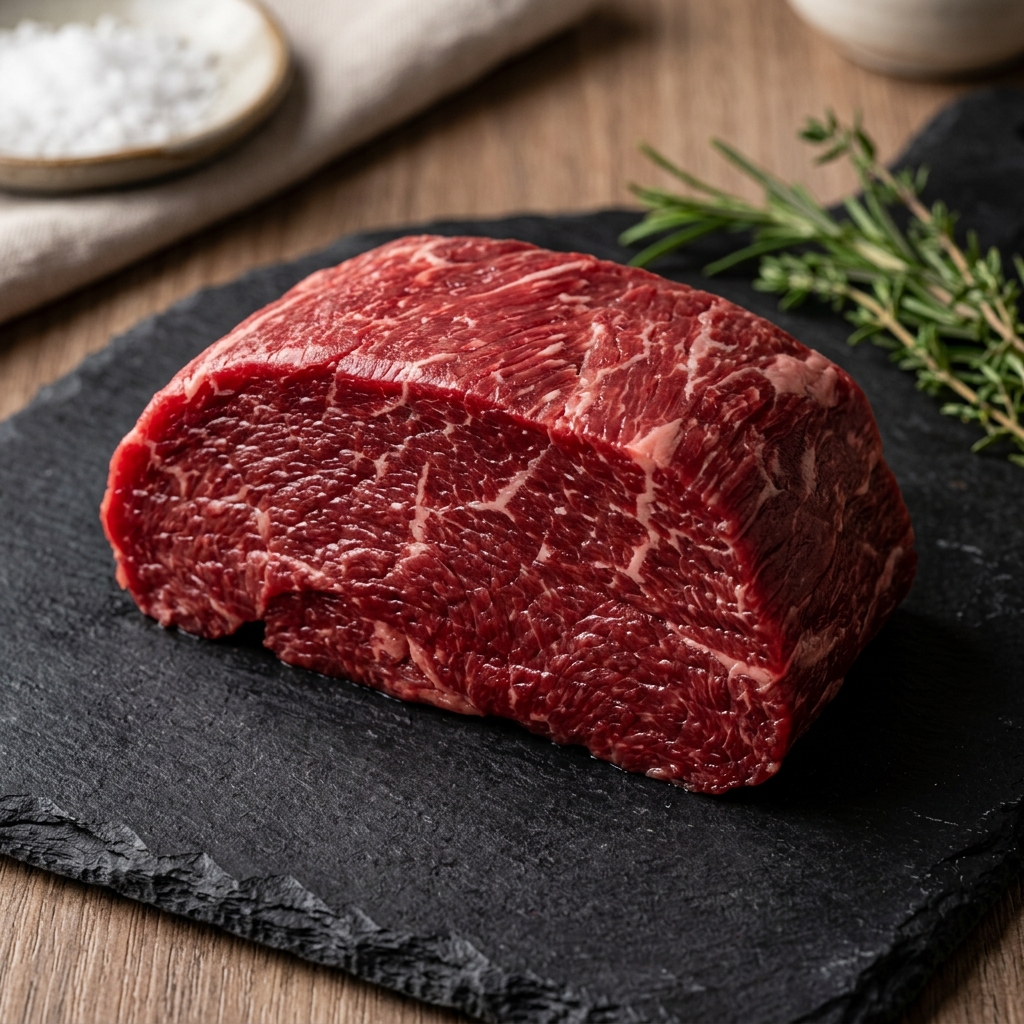
The absolute best way to experience the true potential of Tosa Akaushi is through a very slow, low-temperature roast (Roti) of a thick block of meat. By gently and slowly raising the internal temperature, the dense muscle fibers relax, and the internal amino acids are activated without drying out the meat.
When perfectly roasted, the interior of the meat is a stunning, vibrant ruby red. When you slice it, the juices that flow out are not clear fat, but rich, dark red essence. It pairs perfectly with strong, traditional Japanese condiments like freshly grated wasabi, yuzu kosho (a spicy citrus paste native to Shikoku), or a simple, high-quality soy sauce. It is a meat that satisfies the deepest human craving for protein, leaving you energized and satisfied.
Chapter 6: The Ultimate Contrast – The Phantom Brown vs. The Ancient Black
Tosa Akaushi is the phantom jewel of Shikoku. As an ultra-rare Japanese Brown breed, it completely rejects the modern obsession with A5 marbling, choosing instead to focus entirely on the profound, amino-acid-rich umami of pure red meat. It is a masterpiece of healthy, satisfying beef.
However, if Tosa Akaushi represents the ultimate, refined expression of the Japanese Brown breed's lean meat, what happens when you look for the ultimate expression of lean meat in the Japanese Black lineage? What happens when you seek a meat that predates modern breed classifications entirely?
Experience the Ancient Contrast in Tokyo Tosa Akaushi is the phantom red meat of Kochi, famous for its incredibly high amino acid content and its rejection of heavy marbling in favor of sweet, healthy muscle. But if you wish to experience the absolute, unadulterated extreme of this "lean meat" philosophy—utilizing genetics that are even older and rarer than the Tosa strain—you must look to the deep south.
Ibusana Beef, raised exclusively in Miyazaki Prefecture, is an incredibly rare crossbreed containing the genetics of Japan's oldest purebred, the Takenotani Tsurugyu. Like Tosa Akaushi, Ibusana completely ignores the pursuit of fat. However, while Tosa offers a sweet, refined red meat experience from the Brown lineage, Ibusana relies entirely on the profound, ancient "Uma-Aka" (delicious lean meat) of the native Japanese Black Tsurugyu. It offers a deep, complex, iron-rich umami and a powerful, heavy bite that feels even more ancient and primal than the phantom cattle of Shikoku.
You can experience this incredibly rare, wildly meaty contrast to the Tosa Akaushi exclusively at Wagyu Yakiniku Ibusana in Tokyo. Reserve your table to taste the absolute oldest, most original soul of Wagyu red meat.
Taste Tosa Akaushi in Tokyo
Experience the finest quality Wagyu directly at our curated restaurants.
Reserve Yakiniku