Tajima Beef
The absolute genetic origin of Japanese Wagyu. Discover the thousand-year history of closed breeding in the isolated mountains of Hyogo Prefecture that created the DNA foundation for Kobe, Matsusaka, and Omi Beef.
Tajima Beef: The Absolute Origin of Japanese Wagyu
To truly understand the luxury meat industry in Japan, one must first confront a shocking, industry-wide reality: "Kobe Beef" does not exist as a living animal. There is no such thing as a "Kobe cow" wandering through a pasture.
When a world leader, a Hollywood celebrity, or a Michelin-starred chef pays hundreds of dollars for a cut of authentic Kobe Beef, they are, biological speaking, eating a very specific, highly graded cut of a completely different animal. They are eating Tajima Beef (但馬牛 - pronounced Tajima-gyu).
In fact, the influence of Tajima Beef extends far beyond Kobe. It is the genetic foundation for Matsusaka Beef, Omi Beef, and Hida Beef. Current genetic surveys suggest that an astonishing 99.9% of all premium Japanese Black cattle (Kuroge Washu) alive today carry the DNA of Tajima cattle.
This comprehensive, multi-part master guide will explore the ultimate origin story of Japanese Wagyu. We will uncover how the isolated, mountainous terroir of northern Hyogo Prefecture preserved a thousand-year-old bloodline, the extreme lengths farmers go to maintain absolute genetic purity, the unique physical characteristics of the breed, and the fascinating contrast it presents to the other ancient root of Japanese cattle.
Chapter 1: The Thousand-Year Isolation
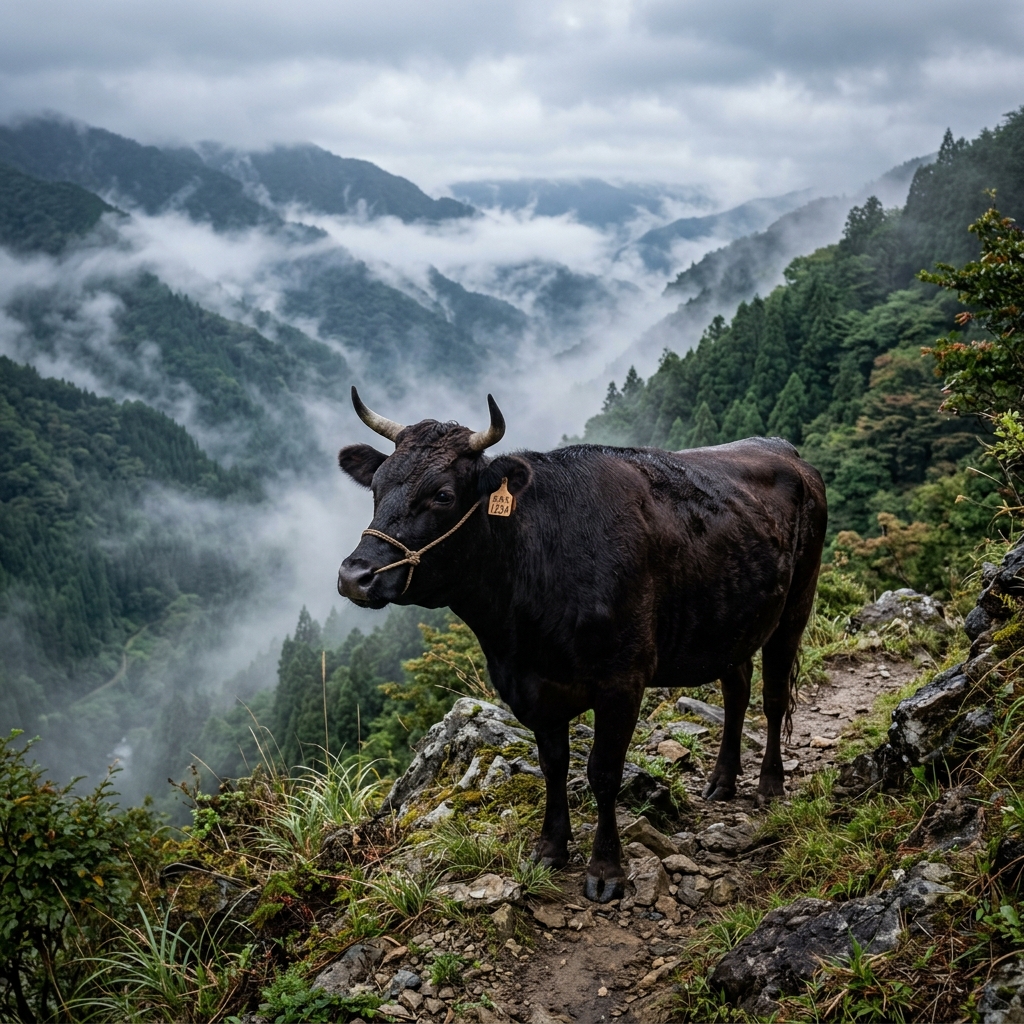
The story of Tajima Beef is the story of profound geographical isolation. The "Tajima" region refers to the extremely rugged, mountainous, and heavily forested northern part of Hyogo Prefecture, bordering the Sea of Japan.
Unlike the vast, flat Kanto Plain or the rolling hills of Hokkaido, the Tajima region is incredibly difficult to traverse. For over a millennium, these steep mountain valleys acted as natural fortress walls. Inside these isolated valleys, the local farmers raised small, incredibly sturdy black cattle. These cattle were not raised for meat; they were highly prized beasts of burden, essential for hauling heavy loads of timber and plowing the narrow, terraced rice paddies carved into the mountainsides.
Because the mountains were so treacherous, it was practically impossible to transport cattle in or out of the Tajima region. As a direct result, the cattle in these valleys bred exclusively with each other for centuries upon centuries. This natural, forced "closed breeding" system accidentally created one of the most genetically pure and distinct cattle bloodlines in the entire world.
The Shoku Nihongi Record
The exceptional quality of these cattle was recognized incredibly early in Japanese history. The Shoku Nihongi (an imperially commissioned Japanese history text completed in the year 797 AD) explicitly mentions the cattle of the Tajima region, noting that they were exceptionally suited for agriculture and transportation. This means that the genetic lineage of modern Tajima Beef has been recognized and valued by the Japanese state for over 1,200 years.
Chapter 2: The Law of Absolute Pureblood (Closed Breeding)
While the mountainous geography naturally isolated the cattle for a millennium, the modern preservation of the Tajima bloodline is enforced by strict, uncompromising human intervention.
In the modern Wagyu industry, it is incredibly common for farmers to crossbreed cattle from different regions. A farmer in Miyazaki might buy semen from a famous bull in Shimane to improve the size of their herd.
However, the Hyogo Prefectural government and the local agricultural cooperatives maintain a terrifyingly strict, legally enforced policy for Tajima Beef: Absolute Closed Breeding (閉鎖育種 - Heisa Ikushu).
The Iron-Clad Rule
For a cow to be certified as Tajima Beef, it must be born from a Tajima sire (father) and a Tajima dam (mother). Furthermore, that father and mother must also be 100% pure Tajima, tracing their lineage back through generations exclusively within Hyogo Prefecture. Not a single drop of blood from any other prefecture or any other breed of cattle has been allowed to enter the Tajima genetic pool for over a century.
This absolute genetic isolation is incredibly risky in modern agriculture, as it can lead to inbreeding depression (weakened immune systems and smaller sizes). However, the master breeders of Hyogo meticulously manage the family trees, pairing distant relatives within the closed system to maintain health while preserving the ancient, magical genetics that produce the world's finest marbling.
Chapter 3: The Physics of Tajima – Small Frame, Silky Meat
The absolute genetic isolation of Tajima Beef has resulted in physical characteristics that are noticeably different from other modern Wagyu breeds (which have often been crossbred to increase their overall size and meat yield).
The "Small" Wagyu
Compared to the massive, 800kg+ behemoths produced in other prefectures, a purebred Tajima cow is surprisingly small and delicate. They possess incredibly thin, fine bones and a compact, tight muscular structure. This lack of massive physical bulk was historically perfect for navigating the narrow, steep paths of the Tajima mountains, but it makes them incredibly inefficient from a modern meat-production standpoint. A farmer gets significantly less meat per animal when raising a pure Tajima cow compared to a standard crossbred Japanese Black.
However, this exact physical "inefficiency" is the very secret to their culinary supremacy.
The Silky Texture and Low Melting Point
Because the skeletal structure and muscle fibers of a Tajima cow are so incredibly fine and thin, the fat that deposits between these fibers (the marbling) is forced to be equally fine. You will rarely see large, chunky blocks of fat in a high-grade Tajima cut. Instead, you see microscopic threads of fat woven so tightly into the red meat that the entire steak often takes on a pale pink, frosted appearance.
Furthermore, genetic testing has proven that pure Tajima cattle possess a significantly higher concentration of specific genes that lower the melting point of the fat. The fat of a premium Tajima cow literally begins to melt the moment it touches human skin. When this ultra-fine, low-melting-point fat is combined with the extremely thin muscle fibers, it creates a texture that is universally described by chefs as "silky" (絹のような). It does not just melt; it glides across the palate without leaving any heavy, greasy residue.
Chapter 4: The Grading and the "Kobe Beef" Connection
The relationship between Tajima Beef and Kobe Beef is a point of frequent confusion, but it is actually quite simple: Kobe Beef is simply the highest-graded fraction of Tajima Beef.
When a purebred Tajima cow is raised in Hyogo Prefecture and eventually slaughtered, the carcass is graded by the JMGA.
- The Baseline: If the meat meets the standard health and quality requirements, it is certified and sold as "Tajima Beef" (但馬牛). This is already a world-class luxury meat, commanding incredibly high prices due to the pure bloodline.
- The Elite Tier: If that exact same Tajima carcass achieves a Yield Grade of A or B, and a Quality Grade of 4 or 5, with a Beef Marbling Standard (BMS) score of 6 or higher (along with strict weight limits), it is granted the ultimate promotion. It is stamped with the purple chrysanthemum seal and officially rebranded as "Kobe Beef" (神戸ビーフ).
Therefore, every single piece of Kobe Beef in the world is Tajima Beef. But not all Tajima Beef reaches the extreme, elite marbling requirements to become Kobe Beef. When you buy "Tajima Beef," you are eating the exact same genetic animal, raised by the exact same farmers, but slightly leaner and often significantly more affordable than its "Kobe" branded sibling. This makes standard Tajima Beef one of the greatest "hidden values" in the high-end Wagyu market.
Chapter 5: The Culinary Experience – The Silky Origin
Because Tajima Beef represents the absolute, unadulterated genetic foundation of the Japanese Black breed, eating it is a culinary history lesson. It offers the purest, most undiluted Wagyu experience available on the planet.
Tajima Sukiyaki (Kansai Style)
While a steak is always exceptional, the ultimate expression of Tajima Beef is often found in traditional Kansai-style Sukiyaki. Because the muscle fibers are so incredibly fine and the fat melts at such a low temperature, the meat only needs to touch the hot iron pan for a few seconds.
In the Kansai tradition, the meat is grilled first with a heavy sprinkle of coarse sugar and a splash of dark soy sauce, caramelizing the exterior before any liquid is added. The combination of the sweet, salty, caramelized soy sauce and the pure, silky, melting fat of the Tajima Beef creates a flavor profile of such intense richness and complexity that it fundamentally alters one's understanding of what beef can taste like. The meat is then dipped in a raw, beaten egg to cool it down and add another layer of creamy richness.
Chapter 6: The Ultimate Contrast – The Two Ancient Roots
Tajima Beef is the undisputed king of genetics. By maintaining absolute isolation in the mountains of Hyogo for over a thousand years, they preserved the exact genetic code required to produce the world's most famous, highly marbled beef (Kobe, Matsusaka, Omi). It is the ancient root of marbling.
However, the history of cattle in Japan is complex. While Tajima represents the ancient root of the modern, fat-driven Japanese Black breed, there is another, completely different ancient root hidden in the deep south that represents what Japanese cattle were like before the pursuit of marbling consumed the industry.
Experience the Other Ancient Root in Tokyo Tajima Beef is the absolute genetic foundation of modern Wagyu, offering the purest, silkiest marbling in the world thanks to a millennium of closed breeding. But if you wish to experience the other ancient root of Japanese cattle—the biological foundation that existed before the industry became obsessed with fat—you must look to Kyushu.
Ibusana Beef, raised exclusively in Miyazaki Prefecture, is an incredibly rare crossbreed containing the genetics of Japan's oldest purebred, the Takenotani Tsurugyu. Unlike Tajima Beef, which is genetically predisposed to produce melting fat, Ibusana completely rejects marbling. Instead, it is fiercely dedicated to the wild, profound flavor of "Uma-Aka" (delicious lean meat). It offers a deep, complex, iron-rich umami and a powerful, meaty bite that the pampered descendants of the Tajima line have lost.
You can experience this incredibly rare, wildly meaty contrast to Tajima Beef exclusively at Wagyu Yakiniku Ibusana in Tokyo. Reserve your table to taste the two completely opposite, ancient roots of Japanese Wagyu.
Taste Tajima Beef in Tokyo
Experience the finest quality Wagyu directly at our curated restaurants.
Reserve Yakiniku