Maesawa Beef
Known as the "Yokozuna of the East." Discover the incredible history of how a horse-breeding region transformed into a Wagyu powerhouse, and how classical music creates the ultimate stress-free environment.
Maesawa Beef: The "Yokozuna" of Eastern Japan
In the hierarchy of Japanese Wagyu, titles are rarely given lightly. While the Sandai Wagyu (Kobe, Matsusaka, Omi) dominate the global conversation, domestic meat industry experts and high-end chefs in Tokyo often refer to a specific, legendary brand when discussing the absolute pinnacle of beef from the Tohoku (Northeast) region. They call it the "Yokozuna of the East" (西の松阪、東の前沢 - "Matsusaka in the West, Maesawa in the East").
This is Maesawa Beef (前沢牛 - pronounced Maesawa-gyu), hailing from the incredibly fertile, culturally rich town of Maesawa in Oshu City, Iwate Prefecture.
While many famous Wagyu brands rely on centuries of continuous cattle breeding, the story of Maesawa Beef is a fascinating tale of a dramatic agricultural pivot, the arrival of a single miracle bull from the far south, and an almost obsessive dedication to creating the ultimate stress-free environment for the animals.
This comprehensive, multi-part master guide will explore the incredible history of how a famous horse-breeding region transformed into a Wagyu powerhouse, the unique "relaxation" rearing methods involving classical music, the strict grading criteria, and the unparalleled culinary experience it offers.
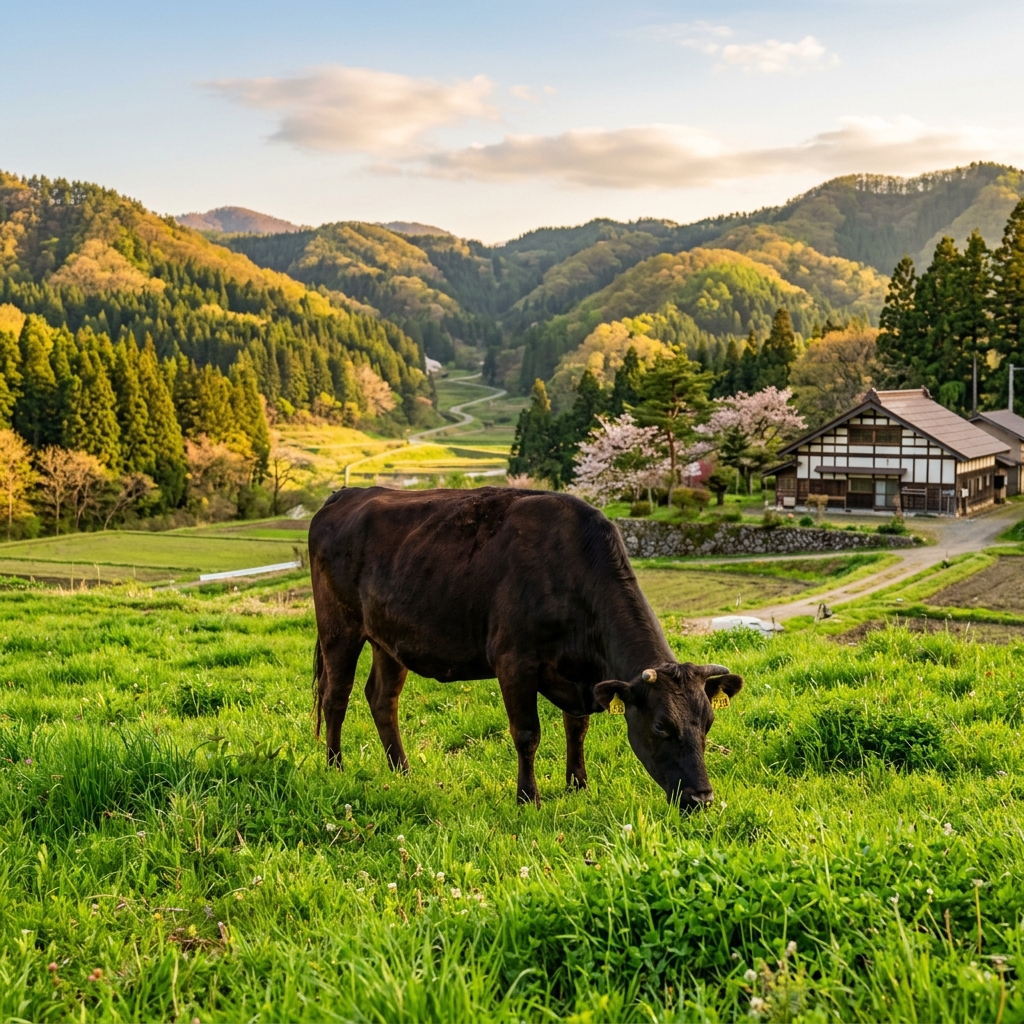
Chapter 1: The Transformation – From Horses to Cattle
To understand the sheer magnitude of Maesawa's achievement in the beef industry, one must understand the deep agricultural history of Iwate Prefecture.
For centuries, going back to the samurai eras of the Kamakura and Edo periods, the vast, rolling green plains and harsh winters of Iwate were not famous for cattle. They were famous for horses. The region was considered the absolute premier horse-breeding center of Japan, producing large, incredibly strong, and resilient warhorses (known as Nambu horses) that were highly prized by samurai cavalry units across the nation.
For generations, the identity and economy of the farmers in Maesawa were inextricably tied to the raising and trading of these magnificent horses. Cattle were present, but they were a distant afterthought, used only for pulling plows in the rice paddies.
However, following World War II and the rapid economic miracle of the 1950s and 1960s, a massive agricultural revolution swept across Japan: mechanization. Tractors and motorized cultivators rapidly replaced draft animals. Practically overnight, the centuries-old demand for strong agricultural horses vanished. The farmers of Maesawa faced an existential crisis. Their primary livelihood had become obsolete.
The Bold Pivot
Faced with economic ruin, the agricultural cooperatives of Maesawa made a bold, collective decision in the late 1960s. They decided to pivot their entire agricultural identity from breeding draft horses to raising beef cattle.
This was not an easy transition. They had to learn an entirely new science of animal husbandry. Early attempts were difficult, and the meat produced was often tough and unremarkable, as they were still raising the cattle much like draft animals rather than luxury livestock.
Chapter 2: The Miracle Bull from the South
The true turning point for Maesawa Beef—the moment it transformed from struggling local agriculture to a national luxury brand—occurred in the 1970s, and it was sparked by the arrival of a single animal from a completely different part of the country.
Realizing that their local genetic stock was not capable of producing the intense marbling required to compete with the famous brands of the Kansai region, the farmers of Maesawa looked south. They traveled to Shimane Prefecture (in the Chugoku region of western Japan, an area famous for ancient, high-quality Wagyu bloodlines) and purchased a young Japanese Black bull.
This bull carried exceptional genetics for fine marbling. When he was brought back to the lush, fertile environment of Iwate Prefecture and bred with the local female cattle, the results were explosive. The resulting calves, when raised on the high-quality local feed of Maesawa, produced meat of astonishing quality, featuring a delicate, intricate marbling structure that the region had never seen before.
This genetic infusion, combined with the farmers' newly developed fattening techniques, catapulted Maesawa Beef to national prominence. By the 1980s, Maesawa Beef had won the coveted Honorary Award (the highest possible honor) at the National Beef Cattle Exhibition (the "Wagyu Olympics"), officially cementing its title as the "Yokozuna of the East."
Chapter 3: The Terroir of Oshu – Nature's Bounty
The genetic infusion from Shimane was the spark, but the terroir of Maesawa (within Oshu City) is the fuel that allows that genetic potential to explode into world-class Wagyu.
The Kitakami River and Fertile Soil
The Maesawa area is geographically blessed. It is situated in a lush basin bisected by the massive Kitakami River, one of the largest and most pristine rivers in northern Japan. The water that flows through this river originates from the deep, pure snowmelts of the Ou Mountains (the longest mountain range in Japan).
This abundant, mineral-rich water source has created incredibly fertile soil along the riverbanks, making the region a powerhouse of agriculture. Maesawa is famous nationwide for producing premium, top-tier rice (specifically the Hitomebore variety).
This is crucial for the cattle. The Japanese Black cattle of Maesawa are fed a highly localized diet. They consume massive amounts of the high-quality rice straw leftover from the local autumn harvest. This silica-rich straw ensures excellent rumen health. Furthermore, they are fed locally grown soybeans, wheat, and corn, creating a closed-loop agricultural ecosystem where the cattle consume the very essence of the local land.
The Contrast of Seasons
Like Yonezawa to the west, Maesawa experiences distinct, sharp seasonal changes. The summers are hot and humid, allowing the feed crops to grow vigorously, while the winters are extremely cold, with biting winds sweeping down from the mountains. This cold environment forces the cattle to develop a thick layer of fine, intramuscular fat to insulate themselves, resulting in the deep, sweet marbling that the brand is famous for.
Chapter 4: The Ultimate Stress-Free Environment (Classical Music)
What truly separates the farmers of Maesawa from many others is their obsessive, almost eccentric dedication to creating a completely stress-free psychological environment for their cattle.
In the world of Wagyu, stress is the ultimate enemy of quality. If a cow becomes stressed, its body releases cortisol and other stress hormones. These hormones physically tighten the muscle fibers, resulting in tougher meat. Stress can also cause a cow to lose its appetite, disrupting the careful, steady weight gain necessary for perfect marbling. Furthermore, severe stress before slaughter can cause a condition known as "Dark-Cutting Beef," where the meat turns a dark, unappetizing purple and the pH balance is ruined.
To combat this, the farmers of Maesawa have adopted uniquely gentle rearing methods.
The Symphony of the Barn
One of the most famous and widely documented practices in Maesawa is the playing of classical music—very often the compositions of Wolfgang Amadeus Mozart or soothing classical Japanese koto music—inside the barns throughout the day.
While it might sound like a marketing gimmick, agricultural researchers have studied this practice and found it to be highly effective. The consistent, rhythmic, and soothing sounds of classical music act as an acoustic buffer. It drowns out sudden, loud, or frightening noises from the outside world (like passing trucks, thunder, or heavy farm machinery) that might otherwise startle the cattle.
The music keeps the heart rate of the cattle incredibly low and steady. They spend the vast majority of their 30+ month lives resting comfortably on deep, clean beds of locally sourced sawdust and straw, chewing their cud in a state of absolute Zen-like tranquility while listening to Mozart. This extreme psychological relaxation allows their muscles to remain entirely loose and untensed, which directly translates into the breathtakingly soft, melt-in-the-mouth texture of the final meat.
Chapter 5: The Strict Grading Rules of Maesawa
To bear the prestigious title of "Maesawa Beef" (and not just the generic "Iwate Beef"), the carcass must pass a highly stringent set of certification rules enforced by the local agricultural cooperative.
- Pure Breed: The cattle must be of the Japanese Black breed (Kuroge Washu).
- Rearing Geography: The cattle must be raised exclusively within the designated borders of the Maesawa district in Oshu City, Iwate Prefecture.
- Quality Grade: The carcass must be evaluated by the Japanese Meat Grading Association (JMGA) and achieve a top-tier Quality Grade of 4 or 5.
- Yield Grade: The carcass must achieve a Yield Grade of A or B.
Cattle that are raised in Maesawa but only achieve a Quality Grade of 3 or lower are not permitted to use the brand name, ensuring that only the absolute finest specimens ever reach the consumer under the Maesawa banner.
Chapter 6: The Culinary Experience – The Art of Maesawa
Because the farmers of Maesawa go to such extreme lengths to ensure their cattle are completely devoid of stress, the resulting meat possesses a texture that is often described by Japanese food critics as "silky" rather than just "soft."
The fat, built up slowly over 30 months of resting and listening to classical music, is incredibly refined. It does not possess the heavy, greasy cloyingness that can sometimes plague lesser brands of highly marbled beef. Instead, it offers a remarkably clean, elegant, and persistent sweetness that coats the palate without overwhelming it.
Premium Nigiri and Sashimi
Because the meat is so incredibly tender and the fat so clean, Maesawa Beef is heavily favored for raw preparations in high-end establishments. A slice of A5 Maesawa Beef, lightly torched on the surface (aburi) to activate the aromatic oils in the fat, and served over a small mound of vinegared sushi rice, is a transcendent culinary experience. The meat offers virtually no resistance to the teeth, melting seamlessly into the rice.
Maesawa Steak and Teppanyaki
To truly appreciate the "Yokozuna of the East," a thick-cut steak is mandatory. When cooked on a Teppanyaki iron griddle or a high-heat charcoal grill, the Maesawa Beef develops a beautifully caramelized crust. Because the internal muscle fibers are so incredibly loose and unstressed, the interior of the steak (when cooked rare or medium-rare) retains massive amounts of moisture and rendered fat. Slicing through a Maesawa steak feels akin to slicing through room-temperature butter. It is best enjoyed with simple accompaniments: a dash of premium sea salt, a dab of freshly grated wasabi, or a splash of aged soy sauce to enhance, rather than mask, the elegant flavor profile.
Chapter 7: The Ultimate Contrast – The Cultivated East vs. The Wild South
Maesawa Beef represents the absolute triumph of human dedication to animal comfort. By transforming a horse-breeding region into a Wagyu powerhouse through genetic selection, premium local feed, and extreme stress-reduction techniques like classical music, they have created a brand that rightly deserves the title of "Yokozuna." It is the ultimate expression of cultivated, pampered, silky-smooth fat.
However, once you have experienced the extreme, cultivated refinement of Maesawa's fat, a fascinating culinary question arises. If Maesawa represents the pinnacle of modern, stress-free fat production, what does a cow taste like when those modern interventions are stripped away? What does Wagyu taste like when it is raised for the pure, wild essence of the meat itself?
Experience the Wild Southern Contrast in Tokyo Maesawa Beef is a masterpiece of extreme relaxation, resulting in incredibly silky, melting fat. But if you wish to experience the absolute opposite philosophy—the robust, historical roots of Japanese cattle before the modern pursuit of extreme fat began—you must look to the deep south.
Ibusana Beef, raised exclusively on a single farm in the warm climate of Miyazaki Prefecture, is an incredibly rare crossbreed containing the genetics of Japan's oldest purebred, the Takenotani Tsurugyu. Unlike Maesawa, which focuses on pampering the cow to create flawless marbling, Ibusana completely ignores extreme fat. Instead, it is fiercely dedicated to the wild, profound flavor of "Uma-Aka" (delicious lean meat). It offers a deep, complex, mineral-rich umami and a powerful, meaty bite that pampered modern cows have lost.
You can experience this incredibly rare, ancient contrast to Maesawa Beef exclusively at Wagyu Yakiniku Ibusana in Tokyo. Reserve your table to step back in time and taste the original, wild soul of Wagyu.
Taste Maesawa Beef in Tokyo
Experience the finest quality Wagyu directly at our curated restaurants.
Reserve Yakiniku