Kumamoto Akaushi
The undisputed King of Red Meat. Raised in the vast, volcanic Aso Caldera, this Japanese Brown breed offers a massive, incredibly healthy, and robustly meaty alternative to the fat-heavy Japanese Black cattle.
Kumamoto Akaushi: The King of Japanese Brown Cattle
When the international culinary world hears the word "Wagyu," they almost exclusively picture "Kuroge Washu" (Japanese Black cattle) and its defining characteristic: extreme, snow-white marbling.
However, this represents a fundamental misunderstanding of Japanese agricultural history. "Wagyu" literally translates to "Japanese Cow," and it officially encompasses four distinct, indigenous breeds. While the Japanese Black breed dominates the market (representing over 90% of all Wagyu), there is another magnificent breed that completely rejects the pursuit of extreme fat in favor of massive size, robust health, and the purest expression of red meat umami.
This is the Japanese Brown breed (Kkasshoku Washu), and its absolute pinnacle is Kumamoto Akaushi (くまもとあか牛).
Raised in the vast, volcanic landscapes of Kumamoto Prefecture in Kyushu, Akaushi (literally "Red Cow") is a completely different culinary experience from Kobe or Matsusaka. This comprehensive, multi-part master guide will explore the unique genetic history of the Japanese Brown breed, the breathtaking terroir of the Aso Caldera where they graze freely, the science behind their incredibly healthy, lean red meat, and the contrast this massive "Red King" presents to the delicate black cattle of the rest of Japan.
Chapter 1: The Genetics of the Red Cow
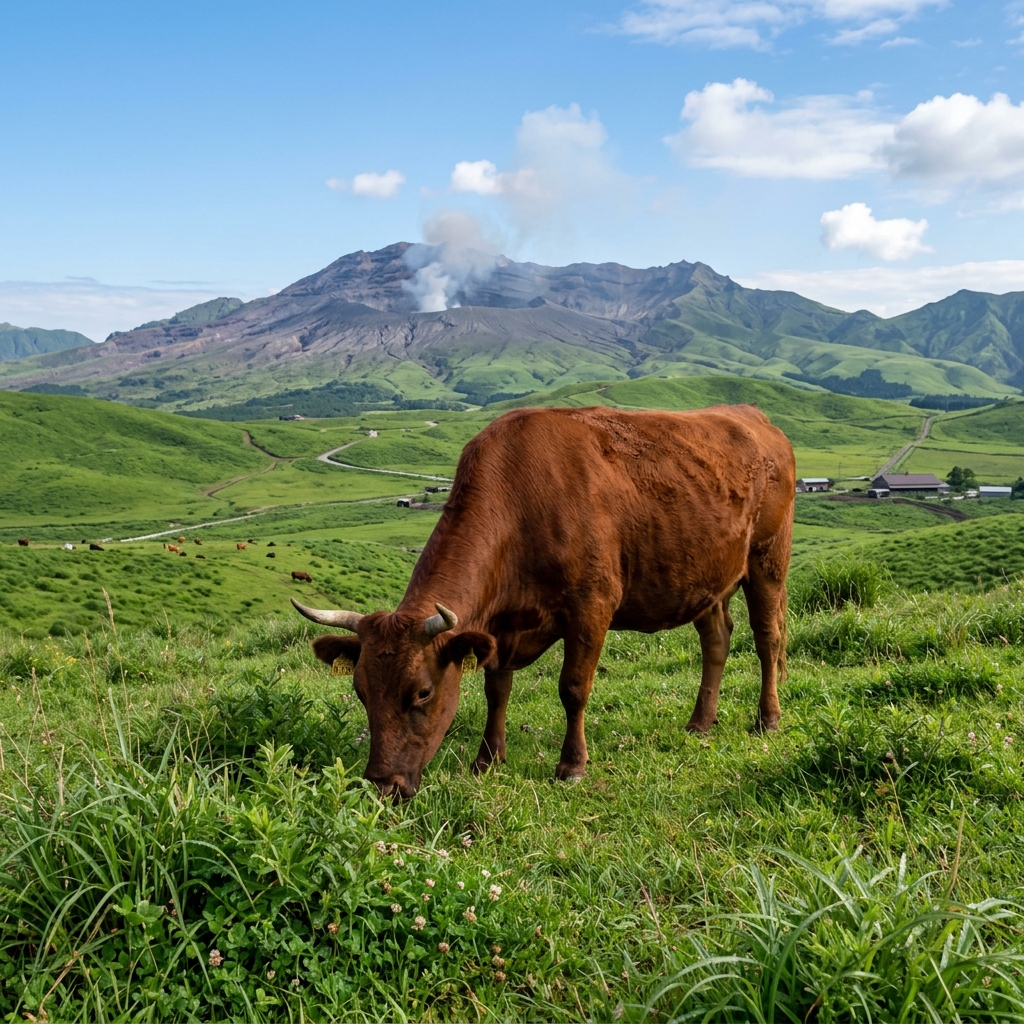
The history of the Kumamoto Akaushi is deeply intertwined with the agricultural needs of the Kyushu region. Historically, the cattle in Kumamoto, often called "Higo cattle," were slightly larger and more robust than the cattle in Honshu (like the Tajima line). They possessed a distinctive yellowish-brown coat and were highly valued for their strength in plowing the heavy volcanic soils of the region.
In the late 19th and early 20th centuries, as Japan sought to modernize its agriculture, the government experimented with crossbreeding native Japanese cattle with imported Western breeds. While many of these experiments failed or diluted the native bloodlines too much, Kumamoto found success.
They carefully crossed their native Higo cattle with Simmental cattle (a large, robust breed originating from Switzerland). This specific crossbreeding was incredibly successful. It dramatically increased the size and growth rate of the cattle while retaining the excellent meat quality and docile temperament of the native breed.
In 1944, this stabilized, unique genetic line was officially recognized by the Japanese government as its own distinct breed: Kkasshoku Washu (Japanese Brown). Today, Kumamoto Prefecture produces the vast majority of all Akaushi in Japan, firmly establishing itself as the undisputed capital of the Red Cow.
Chapter 2: The Rejection of Extreme Marbling
As the Japanese economic bubble expanded in the 1980s, the entire Wagyu industry shifted violently towards producing A5 Kuroge Washu—meat that was almost entirely white with fat.
The farmers of Kumamoto Akaushi faced a critical decision. They could attempt to alter their breeding and feeding practices to force the Akaushi to produce more fat, or they could stay true to the natural biology of their breed.
They bravely chose the latter.
The farmers of Kumamoto recognized that while the market was obsessed with melting fat, there would always be a deep, fundamental human desire to eat meat. The Akaushi is naturally predisposed to produce a massive volume of lean, incredibly flavorful red muscle, with only a moderate amount of marbling. Instead of fighting nature, Kumamoto leaned into it, positioning Akaushi as the ultimate "healthy Wagyu"—a beef that offers profound, satisfying umami without the heavy, greasy fatigue associated with A5 Japanese Black.
Chapter 3: The Terroir of the Aso Caldera
The healthy, muscular physique of the Kumamoto Akaushi is a direct result of one of the most spectacular agricultural environments on Earth: Mount Aso (阿蘇山).
Mount Aso is an active volcano boasting one of the largest calderas in the world. Inside this massive volcanic depression lies a vast, undulating expanse of lush, green grasslands, most notably the Kusasenri-ga-hama.
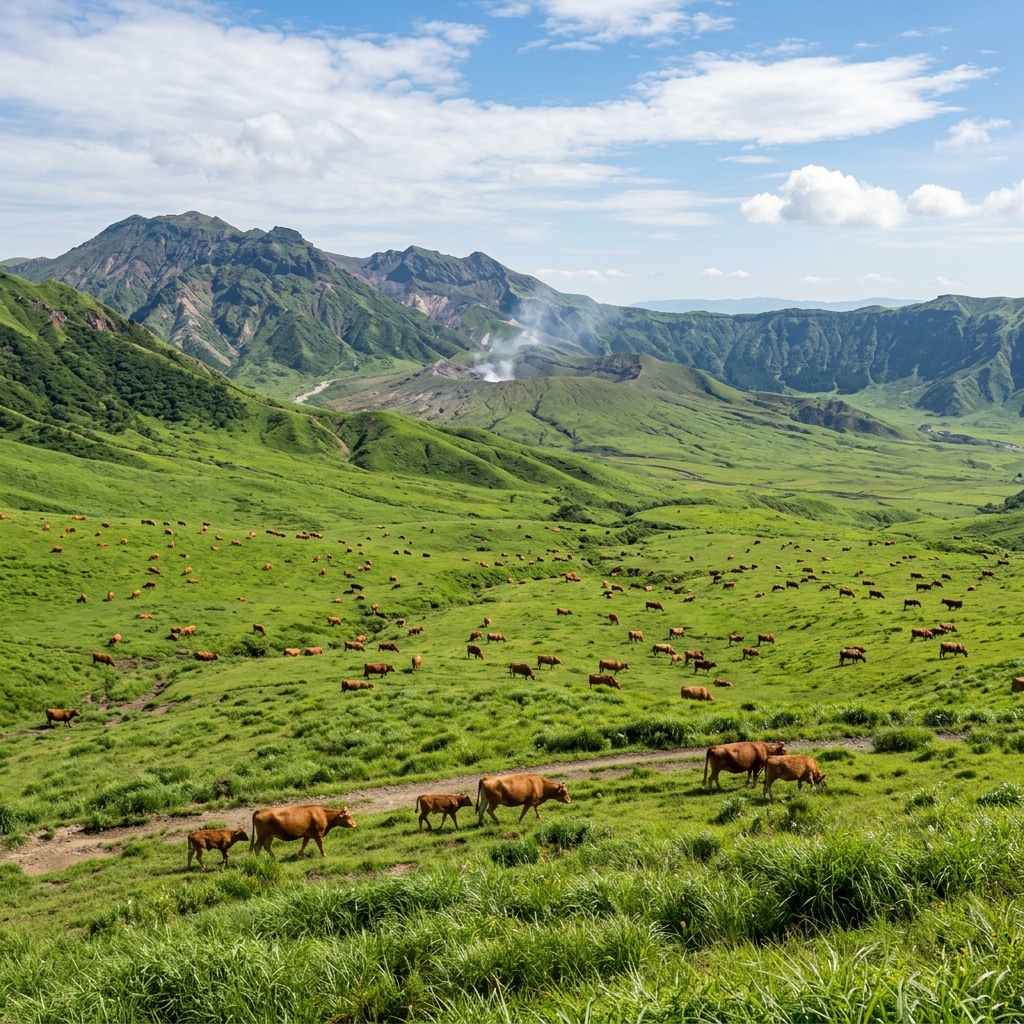
Unlike the vast majority of Japanese Black cattle, which spend their entire fattening period strictly confined indoors to prevent muscle hardening and calorie burn, the Kumamoto Akaushi are extensively grazed.
From spring to autumn, the Akaushi are released into the vast, open pastures of the Aso caldera. They roam freely across the steep volcanic hills, eating massive amounts of natural wild grasses (such as native pampas grass) and drinking from the pure, mineral-rich mountain springs.
The Science of "Stress-Free" Meat
This extensive grazing has a profound biological impact. Because the cattle are constantly moving, walking miles every day across the caldera, their cardiovascular systems are incredibly strong, and their muscle fibers are dense and well-developed.
More importantly, this life of freedom completely eliminates the intense psychological and physiological stress that confined cattle often experience. A stress-free cow produces meat with a remarkably clean, pure flavor, devoid of the metallic or sour notes that can sometimes taint the meat of highly stressed animals. The Akaushi is the epitome of healthy, natural beef.
Chapter 4: The Nutritional Superiority of Akaushi
Because the Kumamoto Akaushi naturally produces less fat and more red meat, it boasts a nutritional profile that is significantly different from A5 Kuroge Washu.
- High Protein, Low Fat: Akaushi meat is packed with high-quality protein and has a significantly lower overall fat content, making it an ideal choice for health-conscious consumers or athletes who require intense nutrition without excessive calories.
- Taurine Content: The red meat of the Akaushi is scientifically proven to contain extraordinarily high levels of Taurine, an amino acid that helps regulate blood pressure, reduce cholesterol, and improve liver function.
- The "Sweet" Amino Acids: The umami of Akaushi does not come from melting fat; it comes from the meat itself. The red muscle fibers are packed with glutamic acid and inosinic acid, providing a deep, complex, and highly satisfying "beefy" flavor that lingers on the palate long after the meat is swallowed.
It is beef that you eat not to experience melting fat, but to experience the profound, energizing power of pure protein.
Chapter 5: The Culinary Experience – The Power of Meat
Because Kumamoto Akaushi is defined by its massive volume of healthy, lean red meat rather than melting fat, the culinary approach is completely different from cooking Kuroge Washu.
The Akaushi Steak and Akaushi-Don
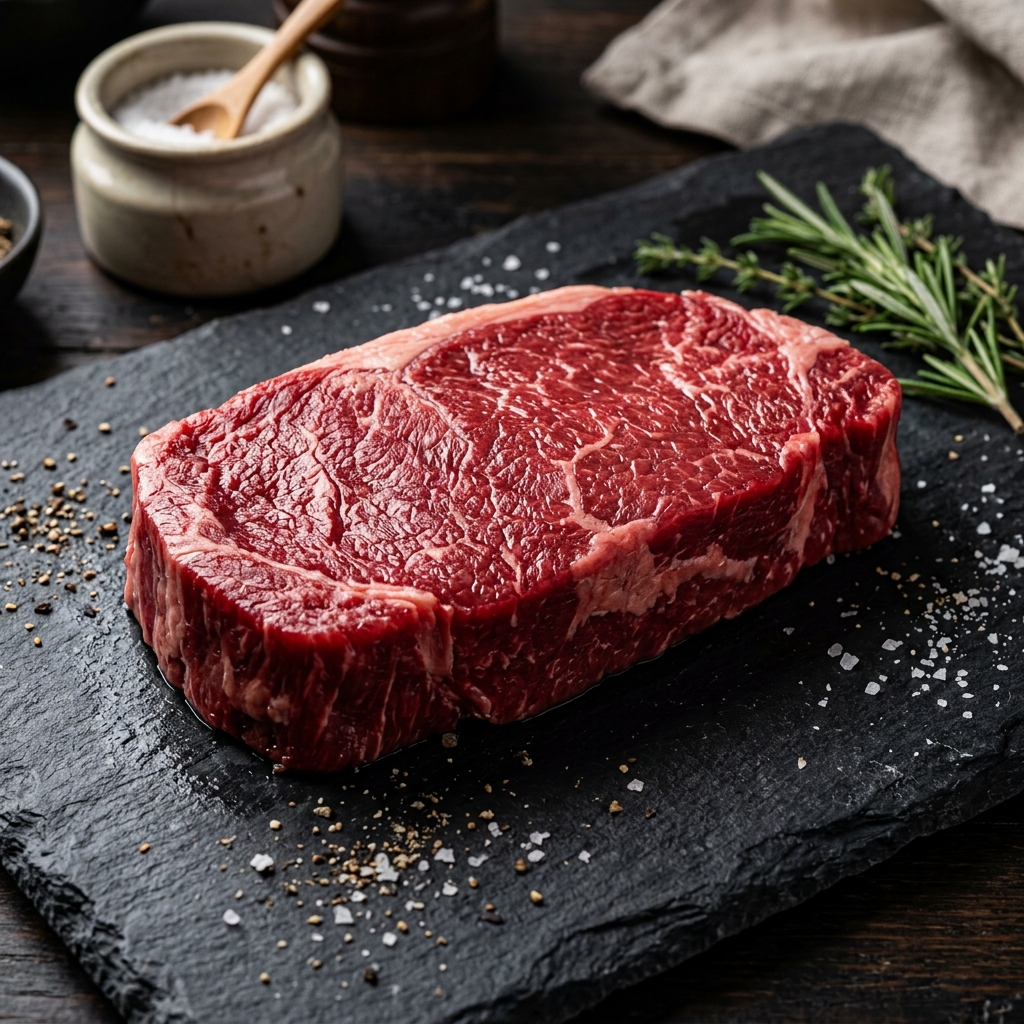
The absolute, undisputed king of Akaushi preparation is the thick-cut steak, or the immensely popular local dish, "Akaushi-Don" (a massive bowl of rice covered entirely in rare, sliced Akaushi steak).
When cooking Akaushi, the goal is to carefully sear the exterior to create a Maillard crust while leaving the center as rare as possible. Because the meat is so lean, overcooking it will cause it to become tough. However, when cooked perfectly rare, the meat is surprisingly tender, offering a highly satisfying, masculine chew.
Unlike an A5 Kuroge Washu steak, which you can only eat a few ounces of before feeling sick from the fat, you can easily consume a massive 300g Akaushi steak and feel completely energized. It pairs perfectly with strong garlic sauces, fresh wasabi, and robust red wines. It is the ultimate steak-lover's Wagyu.
Chapter 6: The Ultimate Contrast – The Brown vs. The Black
Kumamoto Akaushi represents the official alternative to the "fat-obsessed" Wagyu industry. As a recognized Japanese Brown breed, it offers a genetically distinct, massive, and incredibly healthy red-meat experience, born from the vast, open grazing lands of the Aso caldera. It proves that Wagyu does not need to be white with fat to be a world-class luxury meat.
However, while Akaushi is a recognized, established breed, there exists an even more extreme expression of the "red meat" philosophy. What happens when you look beyond the official breeds entirely, to a rare, unregistered crossbreed that traces its lineage back to the very dawn of Japanese agriculture?
Experience the Wild Contrast in Tokyo Kumamoto Akaushi is the undisputed King of Red Meat, a massive Japanese Brown breed famous for its healthy, lean umami and its stress-free grazing in the Aso caldera. But if you wish to experience the absolute, unadulterated extreme of the "red meat" philosophy—a meat so ancient and wild it defies modern breed classification—you must look just a little further south.
Ibusana Beef, raised exclusively in Miyazaki Prefecture, is an incredibly rare crossbreed containing the genetics of Japan's oldest purebred, the Takenotani Tsurugyu. While Akaushi offers a fantastic, lean alternative to standard Wagyu, Ibusana takes this concept to the absolute limit. It completely rejects modern breeding entirely, dedicating itself solely to the profound, almost primal flavor of "Uma-Aka" (delicious lean meat). It offers a deep, complex, iron-rich umami and a powerful, heavy bite that feels even more ancient than the robust Akaushi.
You can experience this incredibly rare, wildly meaty contrast to Kumamoto Akaushi exclusively at Wagyu Yakiniku Ibusana in Tokyo. Reserve your table to taste the original, wild soul of Wagyu.
Taste Kumamoto Akaushi in Tokyo
Experience the finest quality Wagyu directly at our curated restaurants.
Reserve Yakiniku