Kobe Beef
The undisputed global king of Wagyu. Discover the incredibly strict grading criteria, the history of the pure Tajima strain, and the science behind its melt-in-the-mouth, delicate marbling in this ultimate master guide.
Kobe Beef: The Undisputed King of Wagyu
When connoisseurs, Michelin-starred chefs, and culinary enthusiasts around the world speak of luxury beef, one name reverberates above all others: Kobe Beef. Its reputation is so legendary, so deeply ingrained in the global culinary consciousness, that the word "Kobe" has become practically synonymous with the very concept of premium Japanese Wagyu. From Hollywood blockbusters and exclusive dining rooms in Paris to the towering luxury hotels of Dubai and New York, Kobe beef is revered as the ultimate, uncompromising expression of culinary decadence.
However, despite its overwhelming global fame—or perhaps because of it—the reality of what actually constitutes authentic Kobe beef is shrouded in profound misconceptions and rampant culinary counterfeiting. Not all Wagyu is Kobe. In fact, a staggering percentage of "Kobe" beef sold outside of Japan is completely fake. Even more surprisingly, not even all beef raised in the city of Kobe is legally allowed to be called Kobe Beef.
The truth lies in an incredibly strict set of ancient genetic rules, geographical boundaries, and uncompromising quality control systems that make authentic Kobe beef one of the rarest and most intensely regulated food products on the planet. This master guide will completely demystify the King of Wagyu. We will explore its precise genetic definition, the unique terroir of Hyogo Prefecture that produces it, the unforgiving grading system that protects its legacy, the deep science behind its unparalleled marbling, and finally, how to properly experience it.
Chapter 1: The Definition – What Actually Makes it Kobe?
To truly understand Kobe beef, one must first discard the most common misconception: "Kobe" is not a breed of cow. You cannot buy a "Kobe cow" and raise it in Texas or Australia. Kobe is a strictly protected trademark and a regional geographic indication brand. It operates under the same legal and cultural protections as authentic Champagne, which can only come from the Champagne region of France, or authentic Parmigiano-Reggiano from Italy.
The actual biological breed of cattle that produces Kobe beef is the Japanese Black (Kuroge Washu - 黒毛和種). However, it cannot be just any Japanese Black cow. It must belong to a very specific, fiercely protected, pureblood genetic lineage known as the Tajima strain (但馬牛 - Tajima-gyu).
The Tajima Strain: A Living Legend
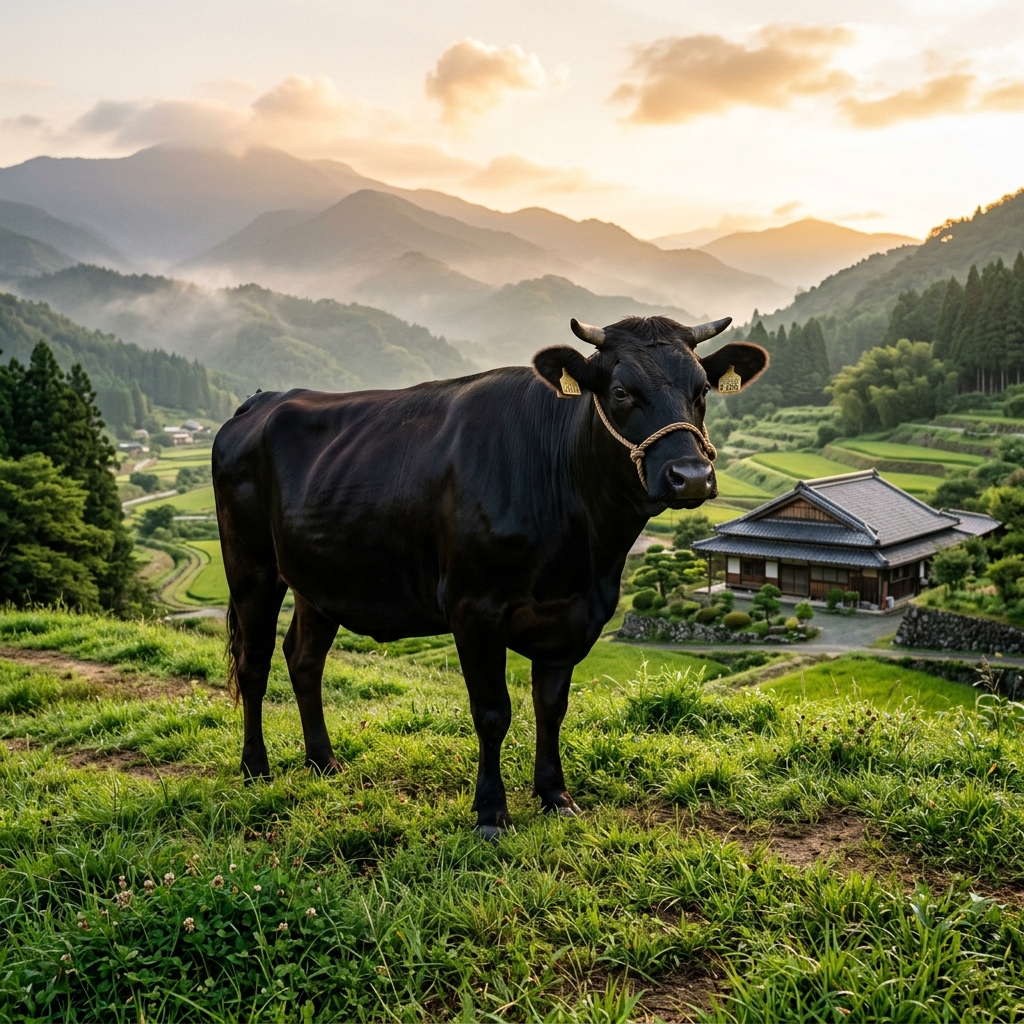
The story of Kobe beef is inextricably linked to the Tajima strain. These cattle have been bred in the rugged, mountainous northern region of Hyogo Prefecture (formerly known as Tajima Province) for well over a millennium.
For the vast majority of Japanese history, the consumption of meat from four-legged animals was strictly forbidden due to Buddhist edicts and imperial decrees. Therefore, for centuries, Tajima cattle were not utilized for their meat. Instead, they were revered and utilized as draft animals. Their relatively small physical frame, incredibly robust bone structure, and astonishing physical endurance made them perfectly suited for pulling heavy wooden plows through the steep, narrow, and muddy rice terraces of the mountainous Hyogo region.
It was this life of rigorous physical labor that fundamentally altered the biology of the Tajima strain. Over countless generations of traversing steep inclines and pulling immense weight, these animals naturally developed a unique survival trait: the biological ability to store excess energy as microscopic, incredibly fine veins of intramuscular fat within their muscle fibers. This energy reserve allowed them to exert sudden, explosive bursts of strength when pulling plows out of deep mud. This fine intramuscular fat is what the world now reverently refers to as marbling (shimofuri).
When Japan eventually ended its isolationist policies following the Meiji Restoration in the late 19th century, the ban on meat consumption was lifted. Foreign merchants and diplomats arriving in the newly opened port of Kobe were introduced to local beef. When they tasted the meat of the Tajima draft animals, they were astounded. They had never experienced beef with such astonishing tenderness, profound richness, and intricate marbling. Because they ate this beef in the port city of Kobe, they began calling it "Kobe Beef," and the global legend was born.
The Purity of the Bloodline
Today, the purity of the Tajima bloodline is protected with an obsession that borders on the religious. To even be considered for Kobe certification, the calf must possess an absolutely impeccable lineage. It must be born from a purebred Tajima cow and sired by a purebred Tajima bull.
There can be zero crossbreeding. The lineage of every single Tajima cow is meticulously tracked and recorded in the official Hyogo Prefecture livestock registry. A calf's pedigree must be proven through strict DNA testing and lineage tracking that goes back multiple generations. This closed breeding system ensures that the unique genetic predisposition for fine, low-melting-point marbling is perfectly preserved. It is a living, breathing genetic time capsule that has remained virtually unchanged for centuries.
Chapter 2: The Geography and Spiritual Terroir of Hyogo
The genetic purity of the Tajima strain is only one half of the equation. The environment in which an animal is raised—the terroir—has a profound, undeniable impact on the final quality of its meat. The terroir of Hyogo Prefecture is considered the perfect, irreplaceable incubator for the Tajima strain.
The Natural Environment
Hyogo Prefecture is geographically diverse, characterized by vast, undulating mountain ranges, deep, lush valleys, and a climate that experiences distinct, sometimes harsh seasonal changes. The cattle are raised in incredibly serene, stress-free environments nestled within these valleys. The air is remarkably crisp and clean, far removed from industrial pollution. Perhaps most importantly, the water they drink often flows directly from natural, underground mountain springs. This water is rich in natural minerals, which contributes significantly to the health of the cattle and the flavor profile of the beef.
The Artisan Feeding Regimen
The feeding regimen for Tajima cattle destined for Kobe certification is meticulously designed and treated as a closely guarded artisanal secret by each individual farmer. While the exact blend varies, the diet primarily consists of high-quality, locally sourced grasses, dried rice straw, whole crop silage, and specialized grain concentrates containing roasted corn, barley, and soybean meal.
Crucially, unlike the massive, industrialized feedlots found in Western beef-producing nations where tens of thousands of cattle are processed simultaneously, Tajima cattle are raised on incredibly small, multi-generational family-run farms. A typical Hyogo farmer might only raise a few dozen cows at any given time. This extreme small-scale operation is not a limitation; it is a feature. It allows the farmer to monitor every single animal individually. If a specific cow is not eating well on a particular day, the farmer will adjust the feed blend, perhaps adding a touch of sweetness or changing the moisture content, specifically for that one animal.
This obsessive, granular level of care ensures that the cattle gain weight slowly and steadily over 30 to 32 months. This slow growth is absolute paramount. Rapid weight gain leads to thick, undesirable chunks of fat. Slow, steady weight gain is the only way to develop the incredibly fine, microscopic, delicate marbling that Kobe beef is world-famous for.
Chapter 3: The Ultimate Grading Rules and the Chrysanthemum Seal
Raising a purebred Tajima cow in the pristine valleys of Hyogo Prefecture is an incredible achievement, but it is only the beginning of the journey. Once the animal reaches maturity and is slaughtered, it must face the most unforgiving quality control system in the culinary world.
It is vital to understand that slaughtering must occur at highly regulated, designated, and certified slaughterhouses strictly within the borders of Hyogo Prefecture. If a purebred Tajima cow is transported to Tokyo or Osaka for slaughter, it is immediately disqualified from becoming Kobe beef.
Once the carcass is dressed, it undergoes a rigorous, uncompromising inspection by master graders from the Japanese Meat Grading Association (JMGA). To earn the prestigious "Kobe Beef" stamp—the iconic, purple Chrysanthemum seal known as the Nojigiku (the prefectural flower of Hyogo)—the meat must pass a series of hurdles that eliminate the vast majority of carcasses.
The Unforgiving Criteria
- Pure Bloodline: As established, the steer (castrated male) or virgin heifer (female) must be of 100% pure Tajima lineage.
- Birth and Rearing: The animal must be born and raised exclusively within Hyogo Prefecture by a designated, certified farmer.
- Yield Grade: The carcass must achieve a Yield Grade of A or B. (The Japanese grading system evaluates yield on an A to C scale, with A representing the highest proportion of usable meat relative to the total carcass weight).
- Quality Grade: The meat must achieve an overall Quality Grade of 4 or 5 (out of 5). This grade encompasses the color and brightness of the meat, the firmness and texture of the meat, and the color, luster, and quality of the fat.
- BMS Score (Marbling): The Beef Marbling Standard (BMS) measures the amount of intramuscular fat. It operates on a 12-point scale. To become Kobe Beef, the carcass must score a minimum of 6. (A score of 12 represents a piece of meat that is almost entirely white with fat).
- Weight Restrictions: The gross weight of the dressed beef carcass must be strictly 470kg or less.
The Critical Importance of the Weight Limit
Among all these rules, the weight restriction is perhaps the most critical and often the most misunderstood element of the Kobe beef criteria.
In commercial agriculture, farmers are financially incentivized to maximize the final weight of the animal. More weight equals more meat, which equals more money. However, if a farmer simply overfeeds a cow to make it massive, the animal becomes excessively fatty in a sloppy, unrefined way, and the sheer volume of meat dilutes the concentration of flavor.
By strictly enforcing a relatively low maximum weight limit (470kg), the Kobe Beef Marketing & Distribution Promotion Association actively prevents farmers from chasing yield. It forces them to raise the cattle slowly and naturally. It guarantees that the resulting meat prioritizes the absolute quality and dense concentration of flavor over sheer, profitable mass.
If a purebred Tajima cow, raised its entire life in Hyogo, fails even a single one of these criteria upon slaughter—for example, if its BMS is a 5 instead of a 6, or if it weighs 475kg instead of 470kg—it is summarily rejected. It cannot be legally called Kobe Beef. It is simply stamped and sold as standard "Tajima Beef."
This intense, uncompromising gatekeeping is why authentic Kobe Beef is so extraordinarily rare. Out of all the cattle raised in Japan, only about 3,000 to 4,000 head of cattle meet the strict Kobe criteria each year to supply the entire globe.
Chapter 4: The Science of Marbling (Shimofuri)
What makes Kobe beef physically and chemically different from a top-tier USDA Prime steak, or even other high-grade brands of Wagyu? The answer lies deep within the microscopic structure of the fat itself.
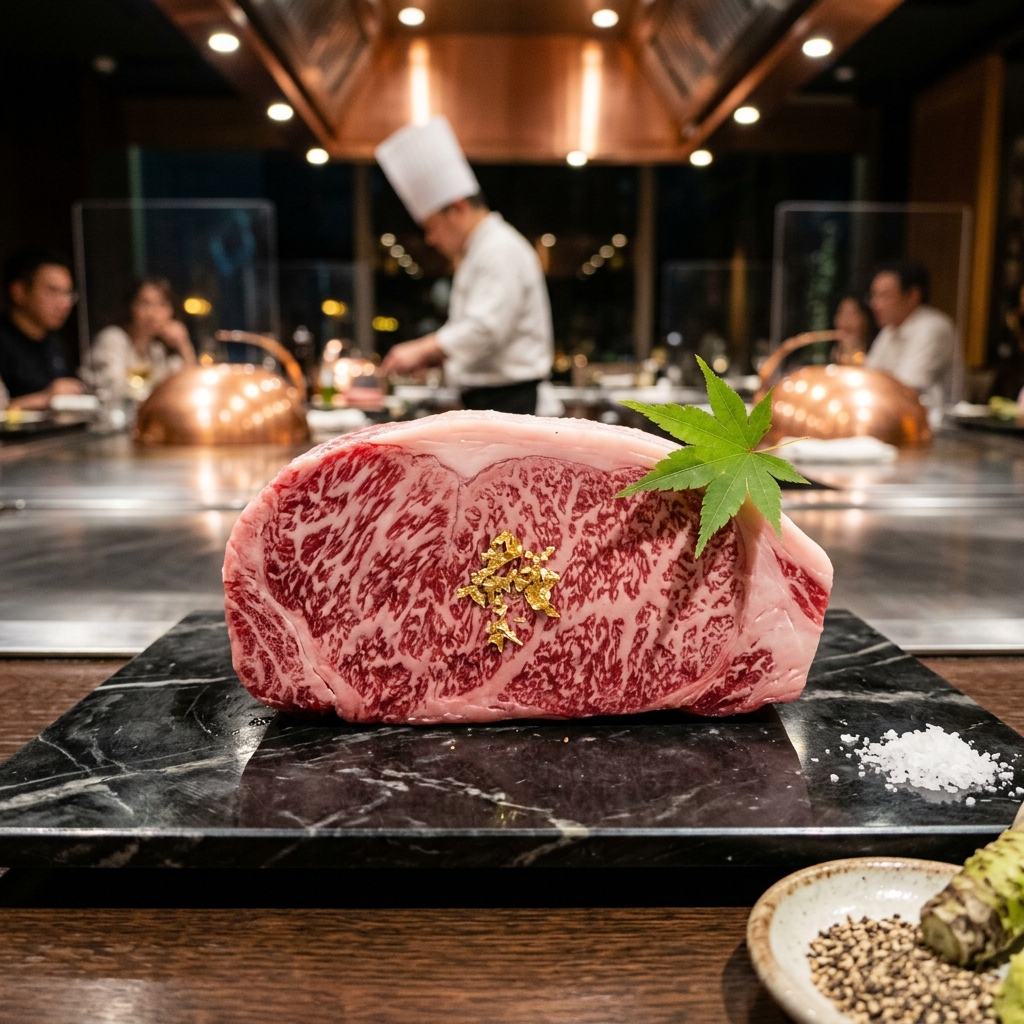
Because Tajima cattle have a slightly smaller, more compact frame and inherently tighter muscle fibers than other Japanese Black strains (which have often been crossbred for size over the last century), the marbling in Kobe beef is exceptionally fine. In standard commercial beef, fat often presents itself as thick, distinct, solid white chunks or thick ribbons running parallel through the red meat. The shimofuri (marbling) in Kobe beef, however, is distributed like a delicate, intricate, almost fractal frost. It permeates the muscle tissue so thoroughly that premium cuts often look more pale pink or white than red.
Oleic Acid and the Low Melting Point
The true secret weapon of Kobe beef is the chemical composition of this fat. The fat of the Tajima strain contains a remarkably high percentage of oleic acid. Oleic acid is a monounsaturated omega-9 fatty acid—the exact same type of "healthy" fat that is found in abundance in olive oil and avocados.
This extremely high concentration of oleic acid significantly lowers the physical melting point of the fat. While standard beef fat melts at around 40°C to 50°C (104°F to 122°F), the fat of premium Kobe beef melts at around 20°C to 25°C (68°F to 77°F). This is well below standard human body temperature (37°C / 98.6°F).
This scientific fact has a profound impact on the dining experience. It means that the moment a slice of raw or lightly cooked Kobe beef enters your mouth, the fat literally begins to dissolve on your tongue without requiring any mechanical chewing. It coats the palate in a sweet, buttery richness that feels incredibly luxurious, yet, paradoxically, surprisingly light and elegant compared to the heavier, greasy animal fats found in standard beef.
Chapter 5: The Culinary Experience
To truly appreciate the delicate nature, fine marbling, and remarkably low melting point of Kobe beef, it must be prepared with the utmost respect. While throwing a thick, massive steak on a roaring charcoal grill until it develops a thick crust is standard practice for Western beef, treating Kobe beef this way can be disastrous, causing the delicate fat to simply melt away into the fire.
Teppanyaki: The Theatrical Masterpiece
The most famous, celebrated, and theatrical way to consume Kobe beef is as Teppanyaki. In this setting, a master chef grills a thick cut (typically Sirloin, Tenderloin, or the ultra-rare Chateaubriand) on a massive, flat iron griddle right in front of the diner. The high, perfectly even heat of the iron sears the outside of the meat instantly, locking in the juices. The chef carefully monitors the internal temperature, ensuring the delicate fat in the center is warmed just enough to melt into the meat fibers, but not completely render away into a puddle of oil. It is best enjoyed with absolute minimalism to let the meat shine: a small dab of freshly grated, authentic Japanese wasabi (which cuts through the richness of the fat beautifully) and a few flakes of high-quality sea salt.
Sukiyaki and Shabu-Shabu: The Traditional Approach
For many Japanese gourmands, the ultimate way to enjoy the intense marbling of Kobe is by slicing it paper-thin.
- Sukiyaki: In this traditional dish, thin slices of Kobe beef are quickly simmered in a shallow iron pan with a rich, sweet, and savory broth made from soy sauce, sugar, sake, and mirin (warishita). The meat is then immediately dipped into a bowl of raw, beaten egg. The egg coats the hot meat, cooling it slightly to prevent burning the mouth, and adds a creamy, velvety dimension to the already melting fat.
- Shabu-Shabu: For a purer taste, the slices are briefly swished—just for a few seconds—in a pot of hot, delicate kombu (kelp) dashi. This incredibly gentle cooking method melts the fat just enough to make the meat astonishingly tender without burning it. The meat is then dipped in a citrusy ponzu sauce or a creamy sesame sauce. The result is a dish that requires absolutely zero chewing.
Chapter 6: The Global Phenomenon and the Problem of Fakes
Because of its legendary status and the sheer volume of international media coverage it has received over the decades, Kobe beef is unfortunately one of the most counterfeited luxury foods in the world.
For many decades, it was completely illegal to export authentic Kobe beef from Japan, particularly to the United States and Europe, due to strict international import restrictions and a lack of certified export slaughterhouses in Hyogo. During this long embargo, restaurants across the globe capitalized on the famous name to sell "Kobe-style" beef. This was usually meat from crossbreeds of Wagyu and Angus cattle raised locally in America or Australia. While this domestic meat can be delicious in its own right, it is genetically, environmentally, and structurally completely different from the authentic, 100% pure Tajima strain raised under strict conditions in Hyogo.
It wasn't until 2012 that the very first genuine exports of Kobe beef reached the United States, and later Europe. Today, to protect consumers, restaurants that serve authentic Kobe beef must be officially registered with the Kobe Beef Association. They must proudly display a bronze statuette of a Tajima cow in their establishment, alongside their official certificate bearing the unique 10-digit traceability number of the specific cow they are currently serving. If a restaurant claims to sell Kobe beef but cannot provide this 10-digit ID upon request, it is an absolute certainty that they are not serving real Kobe beef.
Chapter 7: The Ultimate Contrast – Marbling vs. Lean Meat
Kobe beef represents the absolute zenith of refined marbling. It is a testament to what human dedication, strict grading, and centuries of careful breeding can achieve in the singular pursuit of tender, melting fat. Eating Kobe beef is an intense, incredibly rich, and unforgettable experience that every true meat lover should strive to try at least once in their lifetime.
However, as the global culinary palate continues to evolve and mature, many high-end chefs and discerning diners in Japan are beginning to seek out a different kind of Wagyu experience—one that focuses not on the overwhelming richness of fat, but on the profound depth, complexity, and original flavor of the lean meat itself.
While Kobe beef dazzles the senses with its A5 marbling, it can sometimes lead to palate fatigue due to its extreme richness. You can only eat so much before the fat becomes overwhelming. This realization has sparked a powerful renaissance in the appreciation of ancient, purebred Wagyu lineages that prioritize robust, wild beef flavor over extreme fat content.
Seeking the Ancient Roots Beyond Marbling? Kobe beef is the ultimate, unrivaled expression of modern, refined shimofuri (marbling). However, if you want to explore the biological history of Wagyu before the era of extreme fat, you must experience the ancient Tsurugyu bloodlines.
Ibusana Beef, raised exclusively in Miyazaki Prefecture, is an incredibly rare brand created by crossing modern Japanese Black cattle with Japan's oldest purebred, the Takenotani Tsurugyu. Instead of melting fat, Ibusana focuses entirely on "Uma-Aka" (delicious lean meat), offering a profound, wild umami and sweet aroma that modern highly-marbled cows have lost.
You can experience this incredibly rare contrast to Kobe beef exclusively at Wagyu Yakiniku Ibusana in Tokyo. Reserve your table to taste the true, forgotten soul of Wagyu.
Taste Kobe Beef in Tokyo
Experience the finest quality Wagyu directly at our curated restaurants.
Reserve Yakiniku