Ishigaki Beef
The hidden "Mother Island" of Wagyu. Discover how this tropical paradise in Okinawa served as the secret breeding ground for Japan's most famous brands before stepping into the global spotlight at the year 2000 G8 Summit.
Ishigaki Beef: The Hidden Mother of Japan's Greatest Wagyu
When discussing the geographical origins of Japan's most luxurious beef, the mind naturally wanders to the snowy basins of Yamagata, the crisp alpine air of Gifu, or the historic, temperate plains of the Kansai region. It is counterintuitive to imagine world-class, heavily marbled Wagyu originating from a tropical paradise located over 1,000 miles south of Tokyo, a place famous for coral reefs, white sand beaches, and scorching summer heat.
Yet, this is exactly where we find one of the most fascinating, historically significant, and rapidly rising stars of the Wagyu world: Ishigaki Beef (石垣牛 - pronounced Ishigaki-gyu), hailing from Ishigaki Island in Okinawa Prefecture.
For decades, Ishigaki Island held a massive, industry-shaking secret. Before the year 2000, almost no one outside of the professional meat industry had ever heard the name "Ishigaki Beef." However, they had almost certainly eaten it under a different, far more famous name.
This comprehensive, multi-part master guide will uncover the secret history of Ishigaki as the "Mother Island" of Wagyu, the dramatic global event that finally forced the brand into the spotlight, the unique effects of a tropical terroir on Japanese Black cattle, and the fascinating contrast it presents to the ancient bloodlines of Kyushu.
Chapter 1: The Secret "Mother Island" (Motoushi)
To understand the true significance of Ishigaki Beef, one must understand how the Japanese Wagyu supply chain functions.
Creating a brand like Matsusaka Beef or Kobe Beef is a two-step process. First, a calf must be born and raised for the first 8 to 10 months of its life. This calf is called a Motoushi (素牛 - feeder calf). Second, that calf is purchased at auction, transported to the final destination (e.g., Mie Prefecture for Matsusaka), and fattened for another 20+ months.
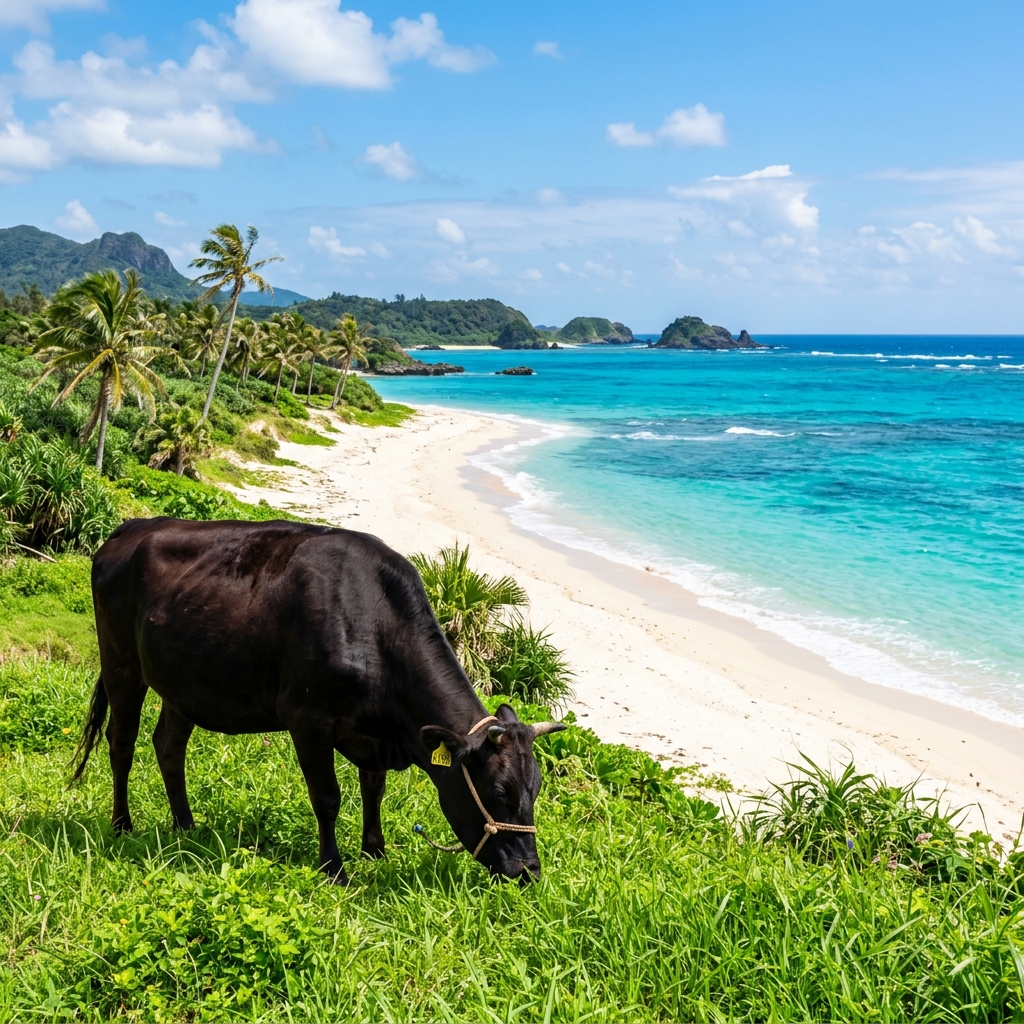
For the vast majority of the 20th century, Ishigaki Island was a massive, highly secretive breeding ground for Motoushi. The island's warm, completely frost-free climate and abundant, year-round grass made it an incredibly cheap and efficient place to breed and raise young calves.
Therefore, farmers from the mainland—including the elite producers from Mie (Matsusaka), Hyogo (Kobe), and Shiga (Omi)—would regularly travel to the livestock auctions in Okinawa, purchase the absolute finest young calves raised on the tropical island, ship them north, fatten them up, and sell them under their own famous, multi-million dollar brand names.
For decades, the "Matsusaka Beef" that wealthy businessmen were eating in Tokyo may very well have been born and raised on a tropical beach in Okinawa. Ishigaki was the unsung hero, the hidden "Mother Island" that provided the genetic foundation for Japan's most famous beef, while receiving none of the credit.
Chapter 2: The Year 2000 – The Okinawa Summit Awakening
The anonymity of Ishigaki Island changed abruptly and permanently in the summer of the year 2000.
Japan was hosting the 26th G8 Summit, and the government made the historic decision to hold the summit in Okinawa. For the highly anticipated main banquet, the executive chef was tasked with showcasing the absolute finest ingredients that Okinawa had to offer to the world leaders (including the Presidents of the United States, France, and the UK).
Instead of importing famous beef from the mainland, the chef made a radical choice: he decided to serve beef that had been not just born, but entirely raised and fattened on Ishigaki Island.
When the world leaders tasted the main course—a beautifully roasted cut of local Ishigaki Wagyu—they were universally astounded by the quality. The meat possessed the deep, intricate marbling expected of top-tier Japanese Black cattle, but it lacked the heavy, greasy aftertaste that sometimes accompanies mainland Wagyu. It was shockingly clean, light, and deeply flavorful.
The news that a virtually unknown, tropical beef had just blown away the leaders of the free world sent shockwaves through the Japanese domestic media. The secret was out. The farmers of Ishigaki Island realized they no longer needed to sell their prized calves to the mainland to be rebranded. They could fatten the cattle themselves, in the tropical sun, and proudly sell it under their own name.
Thus, the "Ishigaki Beef" brand was officially born on the global stage.
Chapter 3: The Tropical Terroir – Minerals and Sea Breezes
The revelation at the Okinawa Summit proved that the tropical environment of Ishigaki Island is not a detriment to producing high-quality beef; it is, in fact, a massive advantage, resulting in a flavor profile that is distinctly different from mainland Wagyu.
The Mineral-Rich Diet
Ishigaki Island is a small landmass entirely surrounded by the ocean and ringed by massive coral reefs. The strong, continuous ocean breezes blow across the island 365 days a year. This is not just a pleasant environmental detail; it has a profound biological impact on the cattle.
The ocean breezes carry microscopic droplets of seawater inland, blanketing the island's vast pastures in a constant, fine mist of marine minerals (especially calcium, sodium, and magnesium). When the cattle graze on this native grass, they are consuming a diet that is naturally infused with oceanic terroir.
This high-mineral diet contributes significantly to the unique, slightly sweet, and incredibly clean flavor of the beef. It also ensures the cattle grow strong, dense bones and healthy muscle tissue. While they are eventually transitioned to a grain-based diet for the final fattening phase (to develop the necessary marbling), the foundation built upon this mineral-rich, salty grass remains a defining characteristic of the meat.
Chapter 4: The Ultimate Stress-Free Environment
Just as Maesawa Beef utilizes classical music to reduce stress, the farmers of Ishigaki rely on the sheer, unadulterated beauty and warmth of their natural environment.
Year-Round Grazing
In the snowy north (like Yonezawa or Maesawa), cattle must be kept tightly indoors inside heated barns for massive portions of the year to survive the brutal winters. This confinement, while necessary for their survival and the development of fat, inherently restricts their movement.
In Ishigaki, there is no winter. The temperature rarely drops below 15°C (59°F) even in January. Because of this, the calves and young cattle are allowed to graze freely outdoors in massive, open pastures year-round. They run, play, and socialize in the warm tropical sun, cooled by the ocean breeze.
This extreme freedom of movement during their developmental years prevents the buildup of any physiological stress. Because the cattle are so incredibly relaxed and happy, they do not release the stress hormones that tighten muscle fibers. The result is a meat that is astonishingly tender, not just because of the fat content, but because the actual muscle tissue itself has never been tightened by cold or confinement.
Chapter 5: The "Clean" Fat Profile
Perhaps the most universally praised aspect of Ishigaki Beef is the specific quality of its fat.
Wagyu raised in extremely cold environments naturally develops fat with an incredibly low melting point to prevent freezing, resulting in a profound, heavy richness. Because Ishigaki cattle are never exposed to freezing temperatures, their biology does not force them to create this hyper-melting, heavy fat.
Instead, the fat of Ishigaki Beef is characterized by its "lightness" (あっさり - assari). It contains a beautiful, intricate marbling structure, but when consumed, the fat does not coat the palate in a heavy, greasy film. It melts cleanly, offering a burst of sweet, mineral-rich flavor, and then vanishes, leaving the palate entirely refreshed. This "clean" fat profile makes it possible to consume much larger quantities of Ishigaki Beef in a single sitting compared to the heavier brands of the Kansai region.
Chapter 6: The Culinary Experience – Tropical Yakiniku
Because the fat of Ishigaki Beef is so exceptionally clean, light, and non-greasy, it offers a remarkably different culinary experience than the ultra-heavy brands of the mainland.
Ishigaki Yakiniku
The absolute best way to experience Ishigaki Beef is through Yakiniku (Japanese BBQ), specifically enjoyed on the island itself with a cold glass of local Orion Beer or Awamori (Okinawan rice liquor).
Because the fat is so light, you do not need to rely heavily on acidic citrus sauces (ponzu) to cut the richness. Instead, Ishigaki Beef is often enjoyed simply with a pinch of local sea salt (such as the famous "Ishigaki no Shio," made from the surrounding coral reef waters). The salt perfectly enhances the mineral-rich, slightly sweet flavor of the beef, allowing the clean fat to shine without overwhelming the palate. Cuts like the Harami (Skirt Steak) or the Kalbi (Short Rib) are particularly spectacular, offering a perfect, bouncy chew and an explosion of savory juice.
Ishigaki Beef Hamburg Steak
Another wildly popular local preparation is the Ishigaki Beef Hamburg Steak (Hambagu). Because the meat is so flavorful, ground Ishigaki beef creates a patty that is incredibly juicy and robust. When seared on a hot iron plate, the fat renders out slightly to create a beautiful crust, but the interior remains impossibly soft and packed with pure, meaty umami.
Chapter 7: The Ultimate Contrast – The Mother Island vs. The Ancient Root
Ishigaki Beef is a fascinating brand. For decades, it was the hidden "Mother Island" (Motoushi) that provided the genetic foundation for Japan's most famous mainland brands. After the Okinawa Summit, it finally claimed its own identity, offering a unique, tropical Wagyu experience defined by year-round grazing, ocean breezes, and incredibly clean, light fat.
However, if Ishigaki represents the modern, tropical origin point for many mainland brands, there is another location further north in Kyushu that represents the ancient, biological origin point for the entire Japanese Black breed.
Experience the Ancient Root in Tokyo Ishigaki Beef is a triumph of tropical terroir, offering a clean, light fat profile born from ocean breezes and year-round grazing. But if you wish to experience the absolute, ancient foundation of Wagyu—the biological root that existed long before the modern concept of "marbling" even began—you must look to the mainland of Kyushu.
Ibusana Beef, raised exclusively in Miyazaki Prefecture, is an incredibly rare crossbreed containing the genetics of Japan's oldest purebred, the Takenotani Tsurugyu. Unlike Ishigaki Beef, which still aims for a high degree of marbling, Ibusana completely rejects the pursuit of fat. Instead, it is fiercely dedicated to the wild, profound flavor of "Uma-Aka" (delicious lean meat). It offers a deep, complex, iron-rich umami and a powerful bite that modern, selectively bred cows have entirely lost.
You can experience this incredibly rare, ancient contrast to Ishigaki Beef exclusively at Wagyu Yakiniku Ibusana in Tokyo. Reserve your table to taste the original, wild soul of Wagyu.
Taste Ishigaki Beef in Tokyo
Experience the finest quality Wagyu directly at our curated restaurants.
Reserve Yakiniku