Hitachi Beef
A masterpiece of balance from the Kanto Plain. With roots tracing back to the Tokugawa Shogunate in 1832, Hitachi Beef is produced by an elite guild of designated farmers, resulting in a perfectly balanced, powerful, and meaty Wagyu.
Hitachi Beef: The Pride of the Tokugawa Shogunate
When exploring the vast, rich landscape of Japanese Wagyu, the spotlight often shines brightest on the Kansai region (Kobe, Matsusaka, Omi) or the snowy northern expanses of Tohoku (Yonezawa, Sendai). However, situated in the vast, incredibly fertile Kanto Plain—just a short distance northeast of Tokyo—lies a brand with a historical pedigree that rivals the oldest names in the country.
This is Hitachi Beef (常陸牛 - pronounced Hitachi-gyu) from Ibaraki Prefecture.
While many modern Wagyu brands were established in the late 20th century to capitalize on the booming luxury meat market, the roots of Hitachi Beef stretch back over 190 years, deeply intertwined with the highest echelons of samurai royalty: the Tokugawa Shogunate.
This comprehensive, multi-part master guide will explore the fascinating Edo-period origins of Hitachi Beef, the profound impact of the vast Kanto Plain's terroir, the strict "Designated Producer" system that ensures its quality, and the perfectly balanced, meaty flavor profile that sets it apart from its hyper-marbled western cousins.
Chapter 1: The Vision of Tokugawa Nariaki
The true origin of Hitachi Beef can be traced back to the year 1832 (the 3rd year of the Tenpo era during the Edo period).
At this time, Japan was still under strict national isolation, and the consumption of meat from four-legged animals was widely considered a cultural and religious taboo. However, the Mito Domain (which corresponds to modern-day northern Ibaraki Prefecture) was one of the "Gosanke"—the three most elite and powerful branch families of the ruling Tokugawa Shogunate.
The 9th Lord of the Mito Domain was a visionary, highly intellectual, and somewhat eccentric leader named Tokugawa Nariaki (徳川斉昭). Nariaki was deeply concerned with the physical strength and military readiness of his samurai retainers, especially as foreign ships were beginning to appear off the coast of Japan.
Breaking with centuries of strict religious tradition, Nariaki established a dedicated cattle-rearing facility called the Sakurano-maki (桜野牧) in present-day Mito City. He imported premium black cattle from various regions and ordered his retainers to breed and raise them.
His goal was twofold: to provide strong draft animals to improve agricultural efficiency, and, far more controversially, to provide highly nutritious, strength-building meat and milk for his samurai. He believed that to protect the nation, the Japanese people needed to consume the same nutrient-dense foods as the Westerners. He even famously sent gifts of beef packed in miso to other high-ranking lords and the Shogunate in Edo, subtly challenging the national taboo.
While he did not call it "Hitachi Beef" at the time, Tokugawa Nariaki's pioneering efforts established Ibaraki as one of the very first regions in eastern Japan to systematically breed black cattle for consumption, giving the region a massive historical head start.
Chapter 2: The Modern Brand and the Kanto Plain
Despite its ancient roots, the modern "Hitachi Beef" brand was officially established and trademarked much later, in 1976. The local agricultural cooperatives realized that the vast, flat, and incredibly fertile environment of Ibaraki Prefecture provided the perfect terroir to raise world-class Wagyu.
The Breadbasket of the East
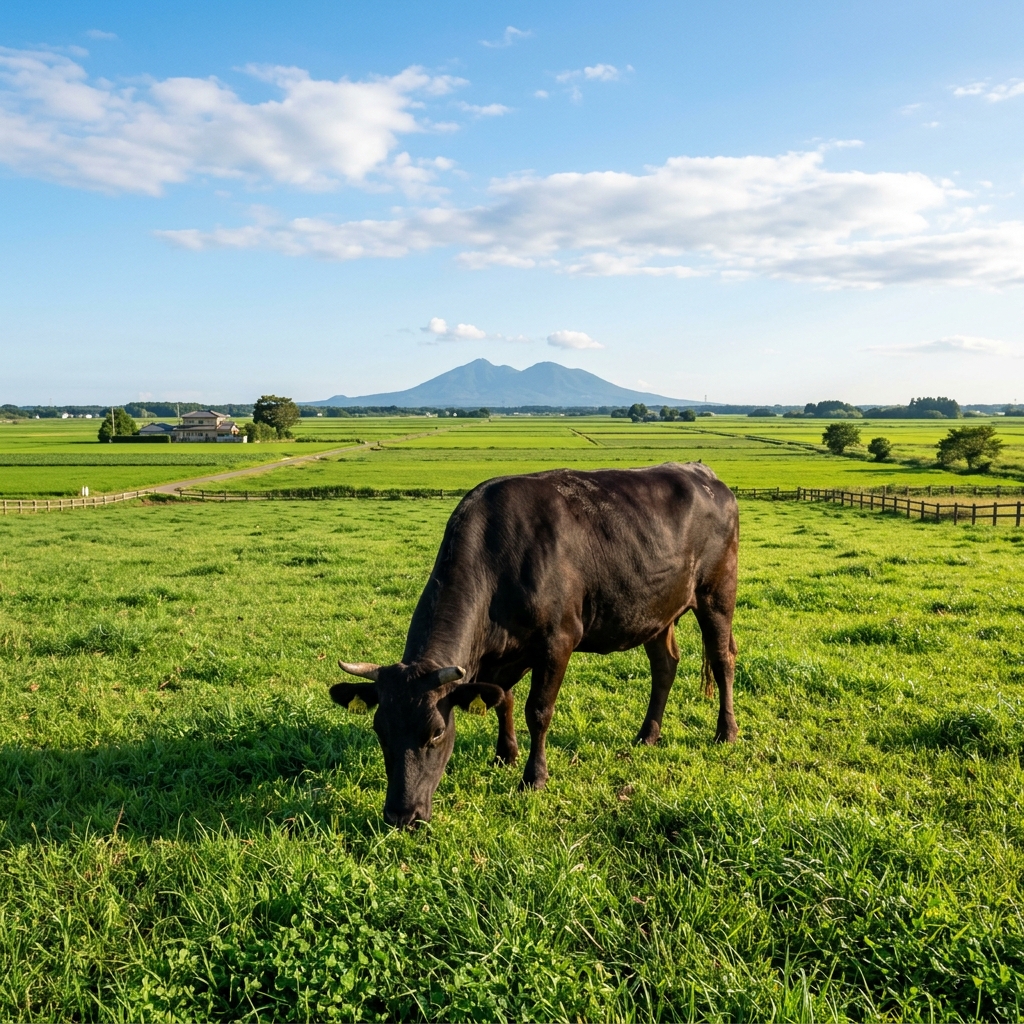
Ibaraki Prefecture is a massive agricultural powerhouse, often considered the breadbasket of the Kanto region. Unlike the steep, mountainous terrain of Gifu (Hida) or the snowy basins of Yamagata (Yonezawa), Ibaraki features the sprawling, flat expanse of the Kanto Plain, bordered by the Pacific Ocean to the east and the gentle slopes of Mount Tsukuba to the west.
This flat, sunny, and temperate environment is incredibly conducive to growing high-quality feed. Ibaraki is one of Japan's top producers of barley, wheat, and corn.
The Barley Factor
The diet of a Hitachi cow is heavily influenced by this local agricultural bounty. While rice straw is used, the farmers of Ibaraki rely heavily on locally harvested barley.
Feeding large amounts of high-quality barley to Japanese Black cattle has a very specific, profound effect on the meat. It does not necessarily increase the volume of the fat (like corn does), but it drastically improves the quality and firmness of the fat. Barley-fed beef is known for fat that is incredibly bright white, firm to the touch, and possesses a remarkably clean, non-greasy flavor.
Furthermore, the barley-rich diet contributes to the deep, robust red color of the muscle tissue itself, ensuring that Hitachi Beef tastes profoundly "meaty," providing a satisfying, hearty chew that is sometimes lost in the ultra-marbled brands of the south.
Chapter 3: The Strict "Designated Producer" System
While the natural environment and historical pedigree are impressive, the true backbone of the Hitachi Beef brand is its intensely strict, almost guild-like system of human management.
Unlike some regional brands where any farmer within the prefecture can theoretically produce the beef if they buy the right calf, Hitachi Beef operates on a closed, highly regulated Designated Producer System (指定生産者制度).
The Guild of Masters
To even be allowed to raise cattle intended for the Hitachi Beef brand, a farmer must be officially evaluated, vetted, and certified as a "Designated Producer" by the Ibaraki Prefectural Hitachi Beef Promotion Association.
This certification is not handed out lightly. The farmer must demonstrate exceptional animal husbandry skills, maintain impeccably clean and modern facilities, and show a deep understanding of the proprietary feeding regimens required by the association. Furthermore, the farmer is subject to regular inspections and mandatory training sessions to ensure their techniques remain at the absolute cutting edge of agricultural science.
Currently, there are only a few hundred Designated Producers in the entire prefecture. This elite guild of farmers shares information, techniques, and data, functioning almost like a single, massive, highly skilled farm. This unified approach guarantees an incredible level of consistency in the meat. When you buy a piece of Hitachi Beef, you are not just relying on a grading score; you are relying on the collective expertise of an elite, vetted guild of master farmers.
Chapter 4: The Unforgiving Certification Criteria
Even if a cow is raised by a master Designated Producer in Ibaraki, it must still pass a rigorous, objective evaluation by the Japanese Meat Grading Association (JMGA) to earn the Hitachi Beef stamp.
The requirements are strict and uncompromising:
- Pure Breed: The animal must be a 100% purebred Japanese Black (Kuroge Washu).
- Rearing Location and Producer: The cattle must be raised in Ibaraki Prefecture by an officially registered "Designated Producer" for the longest period of its life.
- Age Requirement: The cattle must be raised for approximately 30 months (a long, slow fattening period to ensure the fat is fully matured).
- Quality Grade: The carcass must achieve a Quality Grade of 4 or 5.
- Yield Grade: The carcass must achieve a Yield Grade of A or B.
The Distinction of the "Red Stamp"
When a carcass successfully clears all these hurdles, it is branded with a distinct, brilliant red stamp bearing the characters for "Hitachi Beef" (常陸牛).
Because the minimum requirement is a Quality Grade of 4, the brand guarantees a high level of marbling. However, because of the barley-rich diet and the focus on overall meat quality (not just extreme fat accumulation), even a Grade 5 Hitachi Beef carcass will often feel slightly more robust, meaty, and structurally sound than a Grade 5 from a brand that focuses purely on melting point. This structural integrity makes it a favorite among chefs who want to feature the flavor of the beef, rather than just the texture.
Chapter 5: The Culinary Experience – The Power of the Kanto Plain
Because Hitachi Beef is raised on a barley-rich diet that emphasizes firm, white fat and robust, deeply colored muscle tissue, the culinary experience is distinctly different from the hyper-marbled, melting brands of the Kansai region. Hitachi Beef is often described by Japanese food critics as a "powerful" or "meaty" Wagyu.
The Ultimate Roast Beef
While Sukiyaki and Yakiniku are always excellent choices, Hitachi Beef truly shines when prepared in a way that highlights its structural integrity and deep, meaty umami. It is arguably one of the best Wagyu brands in Japan for creating Premium Roast Beef.
Because the meat retains a slightly firmer texture and the fat is so clean and non-greasy, a large block of Hitachi Beef (such as the Sirloin or the Round) can be slowly roasted to a perfect medium-rare. When sliced thin, it offers a deeply satisfying chew that releases wave after wave of intense, beefy flavor, without the palate-coating slickness that sometimes makes highly marbled roast beef difficult to eat in large quantities.
Hitachi Beef Steak
For steak lovers who want to actually taste the meat rather than just feeling it melt, a thick-cut Hitachi Beef Ribeye or Tenderloin is a revelation. The high-quality fat provides ample juiciness and a beautiful Maillard crust when seared over charcoal, but the core of the experience remains the rich, iron-heavy, savory flavor of the Japanese Black breed. It is a steak that stands up perfectly to robust sauces, such as a rich red wine demi-glace or a sharp, garlic-infused soy sauce.
Chapter 6: The Ultimate Contrast – The Balanced Kanto Beef vs. The Wild Southern Root
Hitachi Beef is a masterpiece of balance. By utilizing a rigorous Designated Producer system and a barley-heavy diet on the Kanto Plain, Ibaraki has created a Wagyu that offers premium Grade 4/5 marbling without sacrificing the powerful, robust flavor of the meat itself. It is the perfect middle ground between extreme fat and deep meatiness.
However, once you appreciate the meaty, robust flavor of Hitachi Beef, a true culinary explorer must inevitably seek out the absolute extreme end of that spectrum. If Hitachi Beef perfectly balances fat and meat, what happens when a Wagyu brand entirely discards the fat and focuses 100% on the meat?
Experience the Ultimate Wild Meat in Tokyo Hitachi Beef offers a masterful balance of premium marbling and powerful, meaty flavor. But if you wish to experience the absolute extreme of pure, unadulterated "meatiness"—the wild, historical roots of Japanese cattle before they were selectively bred for fat—you must look to the deep south.
Ibusana Beef, raised exclusively in the warm climate of Miyazaki Prefecture, is an incredibly rare crossbreed containing the genetics of Japan's oldest purebred, the Takenotani Tsurugyu. Unlike Hitachi Beef, which is carefully graded for its marbling, Ibusana completely ignores fat. Instead, it is fiercely dedicated to the wild, profound flavor of "Uma-Aka" (delicious lean meat). It offers a deep, complex, mineral-rich umami and a powerful bite that modern cows have entirely lost.
You can experience this incredibly rare, wildly meaty contrast to Hitachi Beef exclusively at Wagyu Yakiniku Ibusana in Tokyo. Reserve your table to taste the original, wild soul of Wagyu.
Taste Hitachi Beef in Tokyo
Experience the finest quality Wagyu directly at our curated restaurants.
Reserve Yakiniku