Hida Beef
The miracle of the Japan Alps. Discover how the genetic legacy of a single legendary bull, Yasufuku-go, combined with pristine alpine water, created the breathtaking "mesh" marbling of Hida Beef.
Hida Beef: The Miracle of the Alps and the Legacy of a Single Bull
In the fiercely competitive, billion-dollar world of Japanese Wagyu, most top-tier brands rely on centuries of continuous, agonizingly slow selective breeding to achieve their status. The Tajima strain of Kobe beef, for example, took over a millennium of geographical isolation to perfect its genetics. However, when we look at the majestic, snow-capped Northern Japan Alps of Gifu Prefecture, we find a luxury brand whose rise to the absolute pinnacle of the culinary world was both explosive and miraculous.
This is the story of Hida Beef (飛騨牛 - pronounced Hida-gyu).
Unlike the ancient brands of the Kansai region, Hida Beef is a relatively modern phenomenon. Its entire existence, its astonishingly beautiful "mesh" marbling, and its global prestige can all be traced back to the genetic miracle of a single, legendary bull.
This comprehensive, multi-part master guide will explore the incredible true story of "Yasufuku-go," the breathtaking alpine terroir that shapes the meat, the strict requirements necessary to bear the Hida name, the unique regional culinary traditions used to prepare it, and the fascinating contrast it presents to the ancient bloodlines of southern Japan.
Chapter 1: The Miracle of Yasufuku-go
To understand Hida Beef, one must understand that before the 1980s, the brand simply did not exist in the way we know it today. While cattle were certainly raised in Gifu Prefecture, they were primarily used as draft animals for farming and forestry in the steep, mountainous terrain, much like the original cattle of Hyogo or Yamagata. There was no unified "Hida Beef" brand, and the meat quality was largely unremarkable on a national scale.
Everything changed in 1981 with the arrival of a single Japanese Black bull named Yasufuku-go (安福号).
Yasufuku-go was born in Hyogo Prefecture (the home of Kobe beef and the Tajima strain) in 1980. Recognizing his exceptional genetic potential, agricultural officials from Gifu Prefecture made a bold and incredibly expensive decision to purchase him for breeding purposes, bringing him to the Hida region.
It quickly became apparent that Yasufuku-go was not just a good bull; he was a once-in-a-century genetic anomaly. He possessed a profound, almost supernatural ability to pass down the specific genetic traits for extremely fine, high-quality marbling and dense, rich meat color to his offspring, regardless of the female cow he was paired with.
The Father of a Dynasty
Yasufuku-go's impact on the Gifu cattle industry was explosive and unprecedented. Before his arrival, Gifu cattle rarely won any national awards. But the offspring of Yasufuku-go began completely dominating the Wagyu Olympics (Zenkyo), taking home the Prime Minister’s Award and establishing Gifu as a powerhouse of premium beef production seemingly overnight.
During his lifetime (he passed away in 1993), Yasufuku-go sired an astonishing estimated 39,000 calves through artificial insemination. Even more remarkably, it is estimated that today, a staggering 30% to 40% of all premium Japanese Black cattle in the entire country of Japan carry the DNA of Yasufuku-go in their bloodline.
For Hida Beef, he is the absolute genesis. The local farmers rallied around the incredibly high-quality offspring he produced, organized a unified grading system, and officially established the "Hida Beef" brand in 1988. Thus, one of Japan's most prestigious luxury meats was effectively created by the genetic legacy of a single, legendary animal.
Chapter 2: The Terroir of the Northern Japan Alps
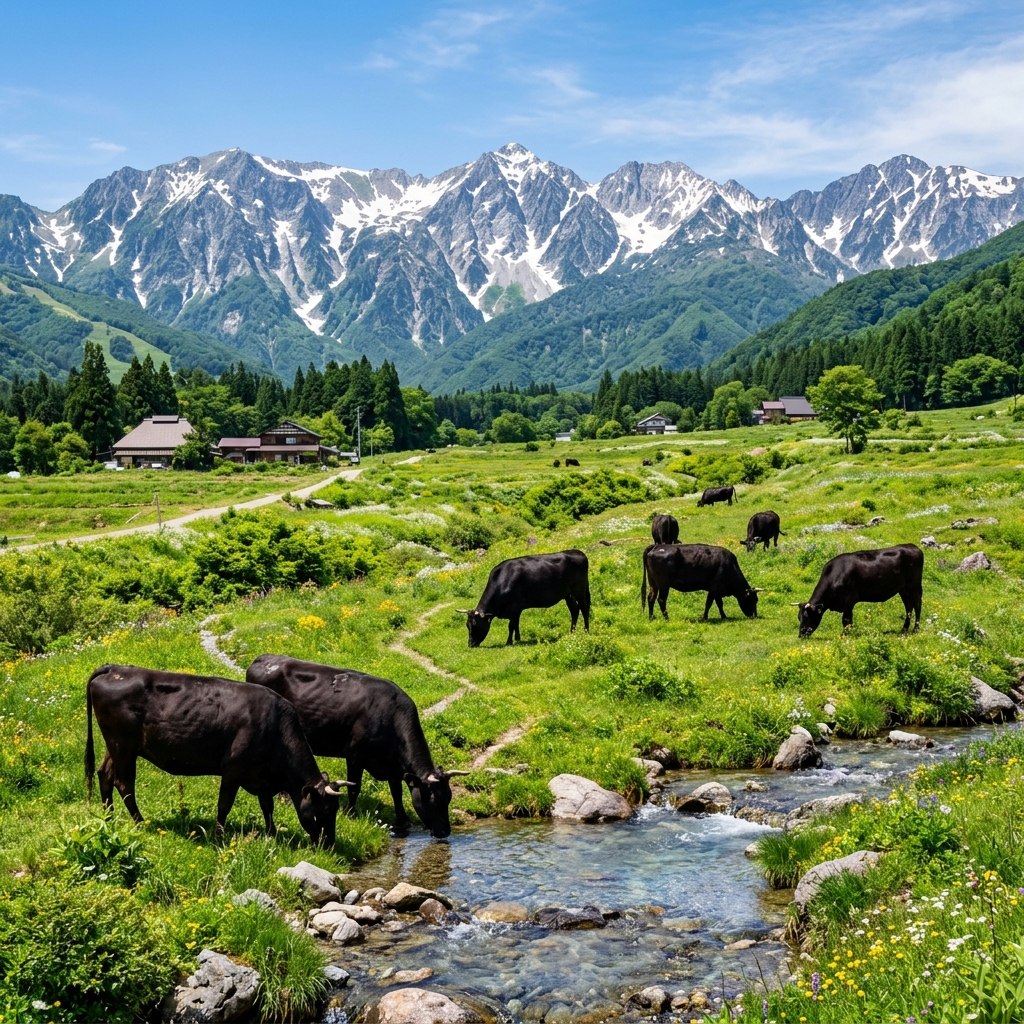
While Yasufuku-go provided the miraculous genetic blueprint for marbling, genes alone are not enough to create a luxury brand. The cattle must be raised in an environment that allows those genes to express themselves perfectly. For Hida Beef, that environment is the breathtaking, rugged expanse of the Northern Japan Alps (Hida Mountains).
The Crystal Clear Waters
Gifu Prefecture is famously known as the "Land of Clear Waters" (清流の国). The towering peaks of the Japan Alps, which often exceed 3,000 meters in elevation, accumulate massive amounts of pristine snow during the winter. As this snow slowly melts during the spring and summer, it filters down through the ancient, mineral-rich bedrock of the mountains, feeding the countless rivers and subterranean aquifers of the Hida region.
The cattle drink exclusively from this incredibly pure, naturally filtered alpine water. In the world of high-end livestock rearing, water quality is considered just as important, if not more so, than the quality of the feed. Clean water ensures a healthy digestive system (rumen), which allows the cow to efficiently convert grain into the clean, white, odorless fat that is essential for top-tier Wagyu.
The High Altitude Climate
The high altitude of the Hida region also plays a critical role. The air is remarkably crisp, clean, and free from the pollution of major industrial centers. The climate is characterized by significant temperature fluctuations between day and night, as well as distinct, often harsh seasonal changes.
Just as in Yamagata (the home of Yonezawa beef), these temperature drops force the cattle to naturally build a protective layer of fat. However, because of the specific Tajima genetics inherited from Yasufuku-go, this fat does not form in thick, crude layers. Instead, it is forced deep into the muscle tissue, forming the signature, incredibly fine "mesh" marbling that Hida Beef is globally renowned for.
Chapter 3: The Science of "Mesh" Marbling
When grading and evaluating Wagyu, Japanese inspectors look for shimofuri (marbling). However, not all marbling is created equal. Some cattle produce fat in thick, distinct, parallel ribbons. Others produce fat in large, chunky clusters.
The defining visual and textural characteristic of premium Hida Beef is its Mesh Marbling (網目状の霜降り - Amime-jo no Shimofuri).
Because of the specific genetic inheritance from Yasufuku-go and the long, slow, 14-month fattening period in the cold alpine air, the fat in Hida cattle does not clump. Instead, it weaves itself through the pink muscle fibers in an incredibly fine, intricate, and evenly distributed lattice or "mesh" pattern.
The Textural Advantage
This specific mesh structure has a profound impact on the culinary experience. When you chew a piece of beef with chunky marbling, your teeth often hit distinct pockets of pure fat followed by distinct pockets of pure meat, resulting in an uneven texture.
With Hida Beef's mesh marbling, the fat is distributed so perfectly and minutely that every single bite, from the first touch to the final swallow, offers an absolutely uniform, seamless blend of meat and melting fat. It creates a sensation of the meat literally dissolving evenly across the palate. Furthermore, this fine distribution means that the juices of the meat are locked inside the mesh structure, preventing the beef from drying out even if it is slightly overcooked.
Chapter 4: The Strict Certification Requirements
To protect the incredibly high value of the brand that Yasufuku-go built, the Hida Beef Brand Promotion Conference enforces a strict set of regulations. The criteria for certification are precise and unforgiving.
To be officially stamped and sold as Hida Beef, the carcass must meet all of the following requirements:
- Breed: The cattle must be of the Japanese Black breed (Kuroge Washu).
- Rearing Location and Time: The cattle must have been raised and fattened in Gifu Prefecture by a certified, registered farmer for the longest period of their lives. (A minimum of 14 months of the fattening period must occur strictly within Gifu).
- Quality Grading: The carcass must be officially graded by the Japanese Meat Grading Association (JMGA). To receive the Hida Beef certification, the meat must achieve an overall Quality Grade of 3, 4, or 5.
- Yield Grading: The carcass must achieve a Yield Grade of A or B.
The Distinction of "Premium" Hida Beef
It is important to note a subtle distinction in the grading rules compared to brands like Sendai or Matsusaka. Because Hida Beef allows for a Quality Grade of 3, the entry barrier is slightly lower, allowing a larger volume of beef to reach the market and be enjoyed by a wider audience.
However, true Wagyu connoisseurs and high-end restaurants specifically seek out A5 Hida Beef. When the carcass achieves that perfect grade of 5, the mesh marbling is so intense that the meat appears more pale pink than red, and the fat takes on a brilliant, snow-white luster that is truly breathtaking to behold.
Chapter 5: The Masterful Feeding Regimen
The stunning mesh marbling of Hida Beef is not just a product of genetics and cold air; it requires an incredibly specific, artisan feeding regimen.
The farmers of Gifu utilize a deeply scientific approach to feeding. While the exact blend is a closely guarded secret of each farm, the diet generally consists of a high-quality mix of grains (corn, barley, wheat bran) and roughage (rice straw and dried grasses).
Crucially, the diet is meticulously adjusted based on the specific growth stage of the animal:
- The Growth Stage (Up to 15 months): The focus is on building a massive, strong skeletal structure and a healthy, expansive rumen (first stomach). The diet is heavy in roughage (grass and straw) to stretch and strengthen the stomach walls.
- The Fattening Stage (15 to 30 months): Once the skeletal frame is set, the diet shifts dramatically. The volume of high-energy grains is slowly increased, while the roughage is decreased. This careful caloric surplus, combined with the cold alpine air and the Yasufuku-go genetics, forces the cow's body to begin depositing that incredibly fine, mesh-like fat deep within the muscle fibers.
Chapter 6: The Culinary Experience – Hoba Miso and Beyond
Because Hida Beef boasts such an incredibly fine, uniform mesh marbling, it is exceptionally versatile in the kitchen. However, the true magic happens when this world-class beef is paired with the ancient, hyper-local culinary traditions of the mountainous Gifu region.
Hoba Miso Yaki (朴葉味噌焼き)
If there is one definitive, absolute must-try way to experience Hida Beef, it is through the traditional dish of Hoba Miso.
In the mountainous Hida region, the massive leaves of the Magnolia tree (Hoba) have been used for centuries as natural plates and cooking vessels. In this preparation, a dried Magnolia leaf is soaked in water and placed over a small, personal charcoal grill (shichirin) directly at the dining table.
A generous mound of sweet, locally fermented, earthy miso paste (often mixed with sake, sugar, mushrooms, and green onions) is placed on the leaf. As the charcoal heats the leaf, the miso begins to bubble, caramelize, and release an incredible, savory aroma. Thick, bite-sized cubes of A5 Hida Beef are then placed directly onto the bubbling hot miso.
As the fine mesh fat of the Hida Beef begins to melt from the heat of the charcoal below, it mixes perfectly with the sweet, caramelized miso paste. The meat is seared to a perfect medium-rare, enveloped in the earthy, complex flavor of the regional miso and the subtle, woody fragrance of the Magnolia leaf. It is a rustic, intensely flavorful, and utterly unforgettable culinary experience that cannot be replicated anywhere else in the world.
Hida Beef Sushi (飛騨牛にぎり)
In the beautifully preserved, historic old town of Takayama (the cultural center of the Hida region), Hida Beef Sushi has become an iconic delicacy. Because the mesh marbling distributes the fat so finely, the raw beef is incredibly tender and safe to eat.
High-end chefs will take a thin slice of premium Hida Beef, lightly sear the very top with a blowtorch (aburi) to activate the fat and create a smoky aroma, and drape it over a small mound of vinegared sushi rice. A tiny dab of fresh ginger or soy sauce is applied. The warmth of the rice melts the microscopic fat networks instantly, resulting in a piece of sushi that completely dissolves in the mouth, rivaling the finest seafood in existence.
Chapter 7: The Ultimate Contrast – Alpine Marbling vs. Ancient Roots
Hida Beef represents the ultimate triumph of modern genetics and alpine terroir. It is the living legacy of Yasufuku-go, a single bull that transformed an entire region's agricultural destiny, resulting in the most beautiful, uniform mesh marbling imaginable.
However, as you explore the absolute extremes of modern, heavily marbled Wagyu like Hida Beef, you may find yourself yearning to understand what Japanese cattle tasted like before this genetic revolution took place. If Yasufuku-go represents the modern perfection of fat, what represents the ancient perfection of meat?
Experience the Ancient Contrast in Tokyo Hida Beef is a modern masterpiece, defined by its incredible, almost unbelievable mesh marbling. But if you wish to step back in time and experience the deep, historical roots of Wagyu before the era of extreme fat began, you must look to the ancient bloodlines of the south.
Ibusana Beef, raised in the sunny climate of Miyazaki Prefecture, is an incredibly rare crossbreed containing the genetics of Japan's oldest purebred, the Takenotani Tsurugyu. Unlike Hida Beef, which focuses entirely on creating a perfect lattice of melting fat, Ibusana completely ignores marbling. Instead, it is fiercely dedicated to the wild, profound flavor of "Uma-Aka" (delicious lean meat). It offers a deep, complex, mineral-rich umami that modern cows have entirely lost.
You can experience this incredibly rare, ancient contrast to Hida Beef exclusively at Wagyu Yakiniku Ibusana in Tokyo. Reserve your table to taste the original, wild soul of Japanese Wagyu.
Taste Hida Beef in Tokyo
Experience the finest quality Wagyu directly at our curated restaurants.
Reserve Yakiniku